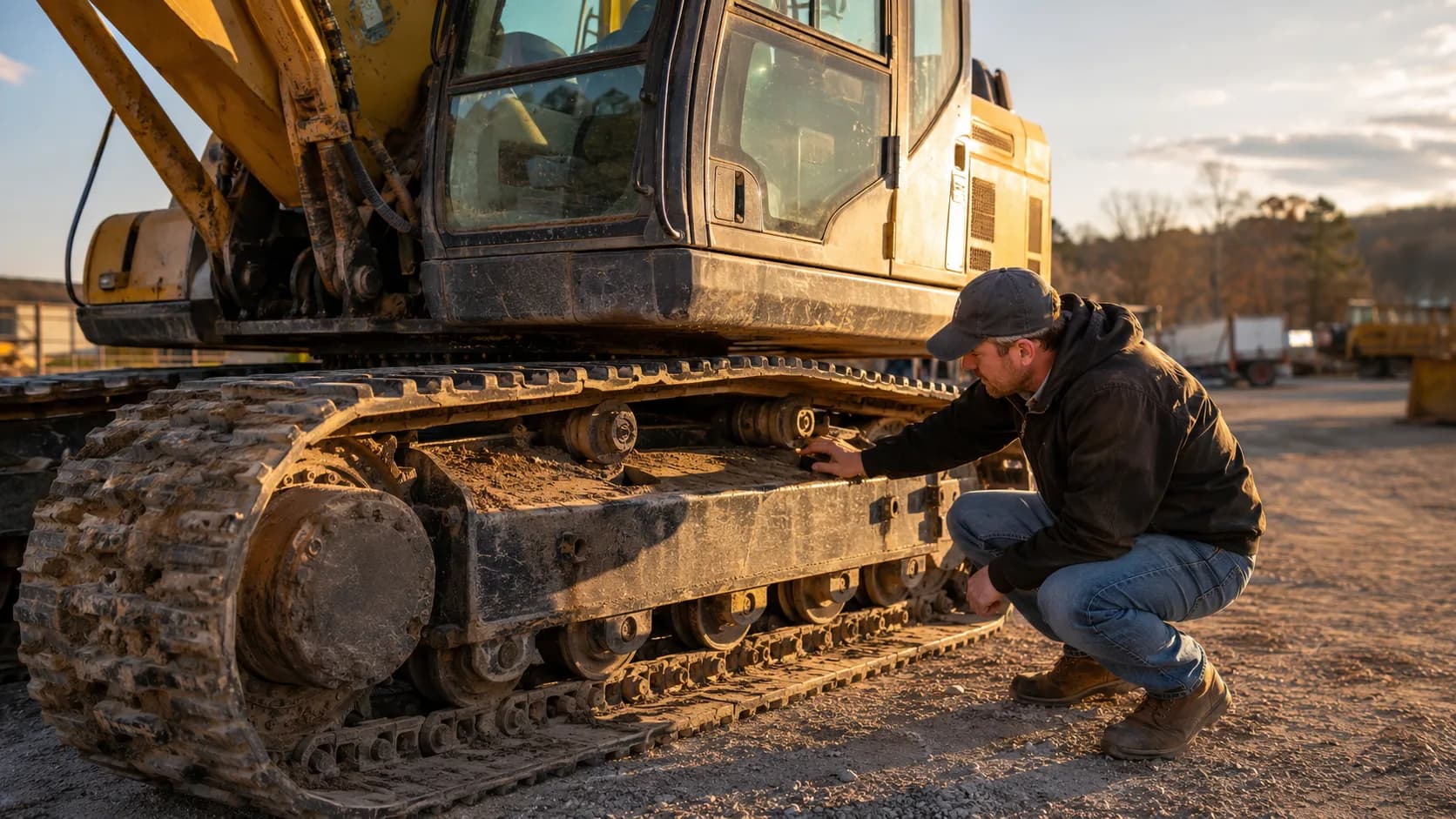
Most used-equipment deals are not lost on price — they are lost on the thing the buyer didn’t check. This is the list to run before you make an offer, in the order that finds the expensive problems first. It is the field companion to our full guide to buying used heavy equipment: that guide is the process and the why; this is the run-it-in-order checklist you take to the yard.
A used machine is worth what its remaining life is worth. Every item below exists to tell you how much of that life is left — and what it will cost to find out the hard way.
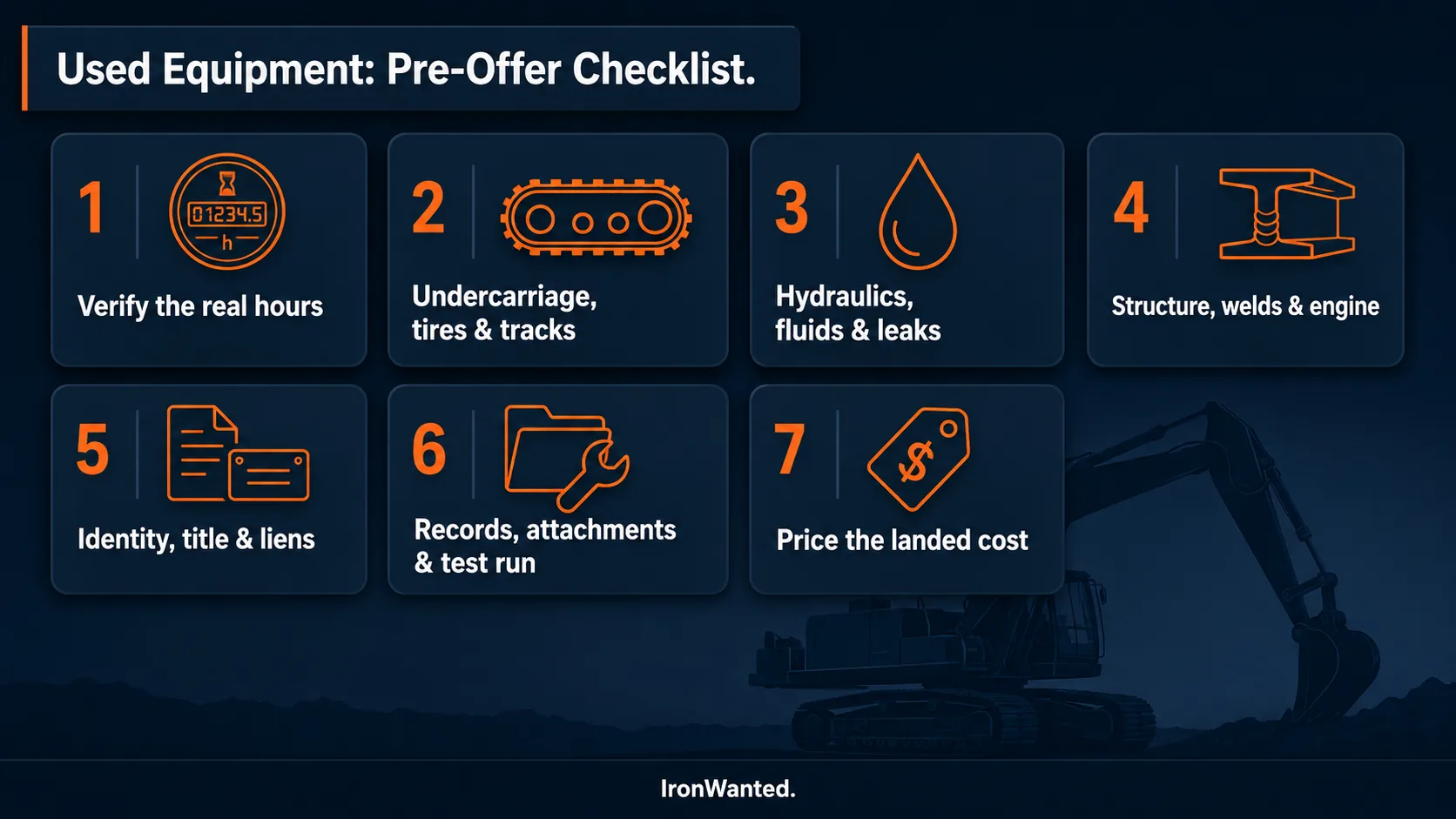
Before you go: line up the deal, not just the visit
Do three things before you drive out. Know what the machine should cost given its year, hours and condition; know your real budget as a monthly payment, not just a price; and ask the seller to have the service records and the machine’s identification plate ready. Walking in prepared is what lets the inspection focus on condition instead of basics.
- Set a target price from comparables. Calibrate against what similar year/hours/configuration machines actually list and sell for, so you can tell a fair number from a hopeful one.
- Know the payment first. Turn your budget into a monthly figure before you shop, so a great machine that’s slightly out of reach doesn’t become an expensive mistake.
- Ask for the paperwork in advance. Service records, the ownership documents and the PIN/serial plate location — a seller who has these ready is already a better sign than one who doesn’t.
1. Verify the hours are real
Hours set expectations, but only if you can trust them. On a modern machine the hours live in the engine ECM, so changing the dash reading means reprogramming or swapping a module — which, as the trade press has reported, can leave a detectable mismatch between the stored hours and the dash. Cross-check the number against the wear you can see.
- Match wear to the meter. Worn joystick grips, a hammered seat, polished pedals and a tired undercarriage on a “low-hour” machine are a contradiction — treat the reading as suspect until it’s explained.
- Ask for an ECM or telematics download. A seller who won’t allow it is a recognized warning sign; if the hours are genuine, the download confirms them.
- Read hours in context. Compare the meter to the machine’s age and ask what it actually did — light utility work and continuous rock or demolition wear a machine very differently. (More on this in how many hours are too many for an excavator and for a skid steer.)
2. Undercarriage, tires and tracks
The wear system that moves the machine is usually the single most expensive thing to put right, so it gets checked early. On a tracked machine the undercarriage is the big one: Caterpillar states that an improperly managed undercarriage can account for more than half of machine maintenance costs, and Volvo CE calls it the most expensive part of an excavator.
- Tracked machines: look at links, pins and bushings, rollers, idlers, sprockets and grouser height, plus cracks, spalling and seal leaks. A documented undercarriage at light wear is a different price than one near the end of its life.
- Rubber-track machines: cracking in the track rubber exposes the internal steel and leads to early failure, so it’s a recognized replace-it signal — and the rollers and sprockets underneath wear too.
- Wheeled machines: check tread depth, sidewall cracking and uneven wear that points to alignment or operator abuse. Tires are cheaper than tracks, but a matched set is still real money.
3. Hydraulics, fluids and leaks
Hydraulic and internal-wear problems are where a quiet machine hides an expensive future. The most powerful single test is fluid analysis, because it reads the inside of the machine without opening it: a Cat S·O·S sample is screened for wear metals plus silicon (dirt) and sodium (water or coolant), and a combined rise in copper and iron in a hydraulic sample points to a failing pump.
- Drift and function. Raise the boom or loaded arm, shut down and watch for it sinking; cycle every function and feel for weak, slow or jerky movement.
- Rods and leaks. Wipe each exposed cylinder rod and look for scoring, pitting or chrome flaking, and check hoses, fittings and final drives for active seepage.
- Fluid condition. Milky or contaminated oil means water intrusion or internal wear. Ask for past fluid-analysis reports and pull a fresh sample before you sign.
- Mind the fresh wash. A just-pressure-washed, freshly painted machine can hide leaks and recent repairs — inspect again after it has run and warmed up.
4. Structure, welds and the engine
Structural and engine problems are rarer than wear, but they are the ones that end a deal outright. Walk the high-stress areas and back the engine walkaround with the same oil sample.
- Cracks and weld repairs. Examine the boom, stick, frame, lift points and attachment pins for fatigue cracks, which grow from repeated load cycles. Treat a past structural weld as a flag to verify it was repaired to standard, not surface-beaded over.
- Engine health. Watch for blowby, excessive smoke, hard starting and leaks; check coolant condition for oil and the oil for coolant.
- Electronics and faults. Scan for active and stored fault codes and check that warning lights, gauges and the climate/cab controls work.
5. Identity, title and liens
Before money changes hands, confirm you are buying a clean machine from someone entitled to sell it. Verify the PIN/serial against an ownership and theft database and search for liens — a service such as the National Equipment Register cross-references theft and ownership records and lien filings.
- Match the plate to the frame. Confirm the PIN plate matches the frame stamping; a mismatch, a re-stamp or a ground-off number is a deal-killer.
- Search for a lien in the right place. A bank or prior seller may still hold a security interest (UCC in the U.S., PPSA in Canada). A machine that has moved across a state or provincial line can hide a filing made elsewhere.
- Get a proper bill of sale. With the PIN/serial on it, naming the seller and confirming the machine is sold free of liens.
6. Records, attachments and the test run
The paperwork and a working test are what turn an impression into evidence. This is also where you confirm exactly what you are buying.
- Read the service history. Consistent intervals and documented major work (with invoices) corroborate the hours and reset part of the machine’s remaining life; gaps signal deferred cost you will inherit.
- Confirm the attachments. Buckets, couplers and other tools quoted “with the machine” are a common point of dispute — check fitment and pin/bushing slop, and get them in writing. (See how to buy used attachments.)
- Run it under load. Travel, steer, swing and work every circuit, listening for noise in the final drives and swing bearing.
7. Price the true landed cost
The number that matters is not the sticker — it is what the machine costs you working in your yard. Add the things that turn a “good deal” into a loss before you compare offers.
- Transport. Distance, dimensions, weight and any permits drive the freight bill. Get a real number rather than guessing — see shipping heavy equipment for what moves the cost.
- Deferred repairs. Every quantified problem from the walkaround — a worn undercarriage, a tired set of tires, a coming service — is a line item, and a negotiating lever.
- Financing. Age and hours affect approval and terms, so confirm the monthly number works on this specific machine. See what gets approved for financing.
A known, quantified repair is a negotiation; a surprise after the sale is a write-off. The whole point of the checklist is to move every cost to the left of the decimal before you sign.
Sources & references
- Caterpillar — What to Know About Excavator Undercarriage Maintenance (more than half of maintenance costs)
- Volvo CE — How to Inspect Your Machine’s Undercarriage and Why It Matters
- Caterpillar — S·O·S Services fluid analysis (what oil analysis detects)
- Farm Equipment — How Widespread Is Hour-Meter Tampering (ECM reprogramming; refusing a download is a red flag)
- National Equipment Register — IRONcheck (PIN/serial theft & lien verification)
- Construction Equipment — Welding standards guide equipment repairs (structural cracks & welds)
- TVH — Four signs it’s time to replace rubber tracks
Last updated .