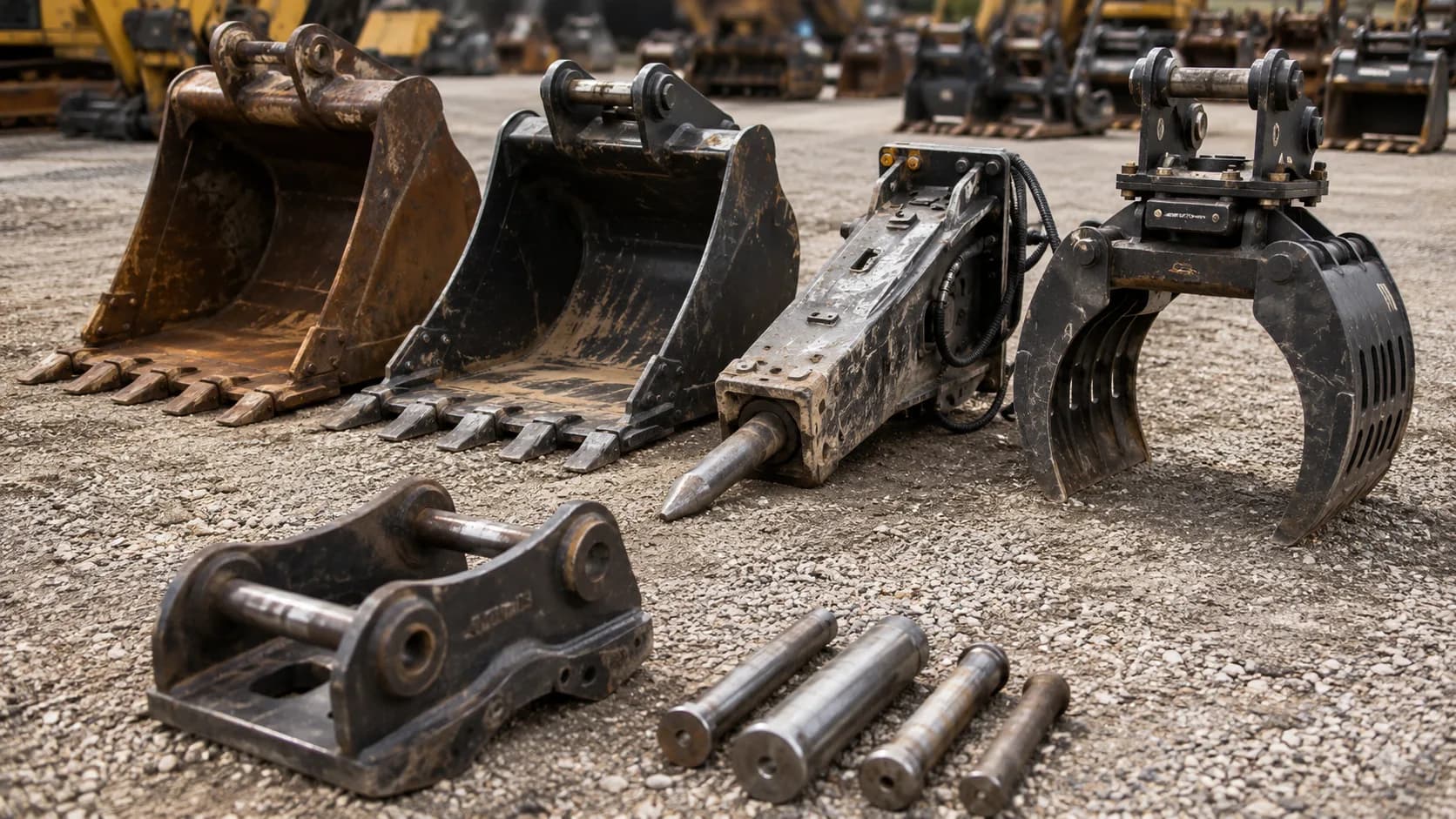
A used attachment is a great deal only if it does three things: physically mounts to your carrier, runs within your machine’s hydraulic limits, and locks on safely. Get any of those wrong and the price was irrelevant. So this guide leads with fitment and coupler safety — the two things that make or break the purchase — then runs the wear checks by attachment type.
The cheapest attachment is the one you can’t use. Confirm it fits and locks before you ever talk price.
Fitment comes first
Fitment is three independent checks, and all three must pass.
- Carrier weight class. Every attachment is rated for a carrier size band. An oversized attachment overloads the machine’s stability, structure and hydraulics; an undersized one underperforms. Pin-and-ear geometry is itself organized into hitch classes tied to machine size, so weight class and mounting class go together.
- Hydraulic flow and pressure (for powered attachments — breakers, augers, grapples, thumbs, mulchers). Match the attachment’s required flow and pressure to what your auxiliary circuit delivers. As an illustrative guide, skid-steer/CTL standard-flow auxiliary runs roughly 17–25 GPM and high-flow ~30–50 GPM; mulchers and cold planers generally need high flow, while augers and small hammers usually run on standard. A handy matching shortcut is hydraulic horsepower = (PSI × GPM) ÷ 1714 — compare the carrier’s output to the attachment’s requirement, not just “standard vs high flow.”
- Mounting interface — pins and coupler. On an excavator, three numbers decide whether an attachment mates: pin diameter, pin center-to-center spacing, and ear (lug) width. Measure all three with calipers and match them to the carrier — or confirm the coupler bridges the gap. On skid steers, verify the “universal” quick-attach plate actually matches; most modern machines share it, but check.
Quick-couplers & safety
This is the part that can kill someone. When an attachment unintentionally releases, it falls on whoever is nearby: NIOSH reported three deaths since 2019 from workers crushed by detached buckets, noting an empty excavator bucket weighs around 900 lb (far more loaded). UK HSE states that many excavator accidents it investigates involve the bucket detaching from a quick-hitch, most resulting in fatal or major injury, and OSHA has issued a bulletin on the same hazard.
Couplers come in pin-grabber (locks onto the attachment pins, accepts varied pin centers) and dedicated/wedge styles, and in manual, semi-automatic and fully-automatic actuation. Semi-automatic hitches cause the most trouble, because operators skip the safety pin to save time. On a used coupler, verify:
- The locking mechanism engages fully. Check the locking jaws or hooks and pins for wear and elongation; it must hold without slack.
- A safety/locking pin or automatic secondary lock is present and works. The safety pin must be in place before lifting any attachment off the ground.
- Prefer a recognized standard. Couplers built to ISO 13031 / EN 474-1 with an independent (secondary) locking system won’t release if the primary system fails.
- Run the connection test. After mounting, crowd the bucket against the ground to try to disengage it — the manufacturer’s “shake, rattle and roll” check — before you ever lift. And never stand under a suspended attachment.
Buckets
- Cutting edge and wear. Check the cutting or bolt-on edge and side cutters for wear and missing bolts, and the side plates for bends and stress fractures.
- Structure and welds. Look for cracks and the quality of any weld repairs.
- Pins and bushings. Feel for slop — excessive play means rebuild cost. Listen for clicking or grinding when working; inspect the pins and bushings and replace worn ones rather than living with the wear.
Hydraulic breakers & hammers
- Tool steel and bushings. Check the moil/chisel for wear, mushrooming and bushing slop.
- Blank-firing and tie-rod damage. Firing the hammer in air shockwaves back through the housing and is a top cause of fractured pistons and destroyed tie-rods — inspect the tie-rods and ask about the machine’s history.
- Seals, charge and a live test. Check for leaks, confirm the nitrogen back-head charge, get the maintenance history, and insist on seeing it run.
Grapples & thumbs
- Cylinders. Check for leaks, scored or bent rods.
- Pivots and tines. Inspect pivot pins and bushings (and that they grease), and tine/tooth wear and cracks.
- Rotators. On a rotating grapple, check the slewing bearing for play.
Augers & mulchers
- Teeth and flighting. Check auger teeth, flighting and the pilot bit; on a mulcher, the rotor teeth or knives.
- Drive motor. Inspect for leaks and confirm smooth rotation.
- Gearbox, bearings and belts. Listen for play and noise, and on belt-driven mulchers check the belts.
- Confirm the flow match. Mulchers in particular need high flow — re-check it against your carrier before you buy.
As with the machine itself, the goal isn’t a perfect attachment — it’s a known one. Price the wear you find, and walk away from any coupler whose locking you can’t verify. For the carrier’s own walkaround, use our buying checklist.
Sources & references
- NIOSH / CDC — Preventing struck-by fatalities from excavator quick couplers (3 deaths since 2019; safety pin; connection test)
- UK HSE — OG-00004, Quick hitch devices on excavators (coupler types; detachment fatalities)
- OSHA — SHIB: Hazards of unintended release of buckets from quick couplers
- Geith — Pin-grab versus wedge-style coupler (ISO 13031 / EN 474-1, independent locking)
- Equipment World — Quick couplers (pin-grab vs wedge geometry & breakout)
- Skid Pro — Skid steer power ratings explained: GPM & PSI (standard vs high flow)
- Mobile Hydraulic Tips — Matching attachments and machines (hydraulic horsepower)
- The Attachment Company — Excavator bucket pin size chart / hitch classes
- GFM Parts — How to inspect excavator bucket pins and bushings
- Gorilla Hammers — What to look for when buying a used hydraulic breaker (blank firing, tie-rods)
Last updated .