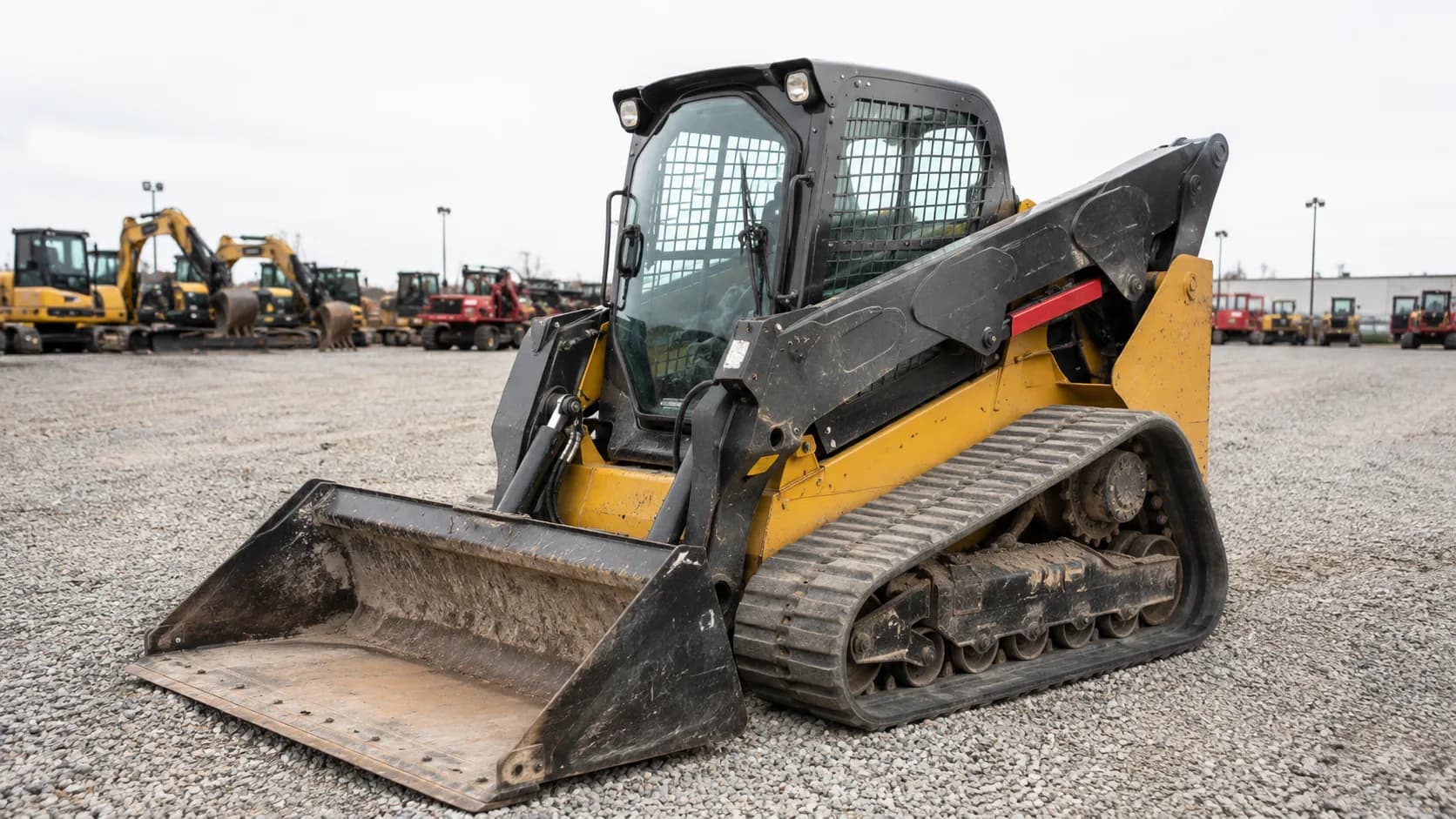
There is no hour number that automatically makes a skid steer “too old to buy.” A well-maintained machine with full records can easily outlast a low-hour one that was abused and skipped its services. Hours tell you how long the clock has run; condition, application and documentation tell you what that running did to the machine. And on a compact track loader, the most expensive truth — the undercarriage — isn’t on the meter at all.
Ask a different question than “how many hours?” Ask “how hard were they, what do the records show, and how much track is left?”
Is there an hour cutoff? Not really
The widely repeated line that a skid steer “lasts about 5,000 hours” comes from dealer and marketing blogs, not from any manufacturer spec or appraisal data — treat it as a conversation-starter, not a rule. No OEM publishes a defensible low / moderate / high band, because usable life depends far more on maintenance and the kind of work the machine did than on the meter. A higher reading is a reason to inspect harder, not an automatic no.
Read hours against age and application
The same hour count means very different things depending on how those hours were earned.
- Application. Abrasive, high-duty work — demolition, scrap, quarry, mulching — ages a machine far faster than landscaping or snow clearing. Ask what the machine actually did.
- Hours per year. A lightly used four-year-old machine can be healthier than a two-year-old that ran full-time. Very low hours for the age can also mean it sat, which brings its own problems — seals, hoses, batteries and fluids.
- The same logic as bigger iron. This is exactly the frame we use in how many hours are too many for an excavator — condition you can prove beats the number every time.
Hydraulics, loader arms and the engine
The hydraulics and loader linkage are the heart of a skid steer, and they show abuse clearly if you test them.
- Hold-test the lift and tilt. Raise and crowd the loader, shut down, and watch: the arms and bucket should hold position and not drift down. Sinking points to worn cylinder seals or valve wear.
- Rods, hoses and pins. Check cylinder rods for scoring and leaks, hoses for wet spots, and the lift-arm pins and bushings for slop.
- The engine. Skid-steer diesels live in dust and high load. Watch for blowby, smoke, hard starts and coolant condition, and on newer Tier 4 machines confirm the emissions system and regen are healthy.
Tires vs tracks — the compact-track cost trap
This is the single biggest difference between two otherwise similar machines. A wheeled skid steer rides on tires — a relatively cheap, quick-to-swap consumable. A compact track loader rides on a rubber-track undercarriage that is a major, recurring cost the hour meter never shows.
ASV’s reliability lead Buck Storlie puts rubber-track life around 2,000 hours on average — up to roughly 5,000 if well maintained, but as low as about 500 if neglected; steel-embedded tracks average closer to 1,000 hours. Counter-rotating, spinning the tracks, and abrasive ground are the top killers. And the tracks aren’t the whole story:
- Inspect the full undercarriage. Rollers, idlers, sprockets and drive lugs wear alongside the tracks. ASV flags drive lugs and sprocket components for replacement around 50% wear, so a cheap-looking track price can hide a full undercarriage rebuild.
- Price the track condition separately. For the same hours and price, a CTL carries more hidden wear risk than a wheeled machine — always treat near-term track spend as money off your offer.
- Wheeled machines: check tread, sidewalls and even wear, and budget a matched set if they’re tired.
Attachments, couplers and auxiliary hydraulics
A skid steer is only as useful as what it can run, so the front of the machine matters.
- Quick-attach plate. Check the plate for cracks and that the locking pins fully engage and aren’t worn or sloppy.
- Auxiliary flow. Test the auxiliary hydraulics with an attachment if you can — weak flow, leaks or contaminated couplers signal abuse. Standard-flow vs high-flow capability also affects what the machine can run and what it’s worth.
- Buying the attachments too? Match them properly — see how to buy used attachments.
Records, fluid analysis and the meter
The cheapest insurance on a used skid steer is paperwork and a fluid sample.
- Service history beats the number. Documented oil and filter intervals and any repairs are worth more than a low reading on the clock.
- Sample the fluids. A Cat S·O·S sample reads wear metals, dirt and water in the oil, exposing internal problems no walkaround can see. Ask for past reports and pull a fresh one.
- Trust, then verify the hours. Meters can be rolled back or swapped — one shop openly advertised meter programming, and in a documented case a machine read about 7,800 hours on the dash but 12,300 in the engine ECU. A dealer ECM download settles it; refusing one is a red flag.
How hours move price
Hours are a major input to value, but they interact with brand, size, condition and attachments — and, on a track loader, with how much undercarriage is left. Rather than trust a seller’s framing or a price-by-hour rule from a blog, benchmark the specific make, model and hour range against real comparable sales, and discount for any near-term track or service spend. The practical move is to shop payment-first: know what the machine should cost given its hours and condition, then confirm the monthly number works before you fall for a specific unit.
Sources & references
- Caterpillar — S·O·S Services fluid analysis (what oil analysis detects)
- Caterpillar — Fluid Analysis 101 (wear metals, dirt, water in oil)
- Compact Equipment Magazine — Caring for CTL tracks & undercarriage (Buck Storlie, ASV — track life in hours)
- ASV — Understanding Undercarriages (CTL wear components and replacement thresholds)
- Westerra Equipment — Used skid steer buying guide + inspection checklist (boom/bucket hold test)
- Makana — How to verify machinery operating hours (ECU vs meter mismatch case)
- Farm Equipment — How widespread is hour-meter tampering (meter programming; ECM download)
Last updated .