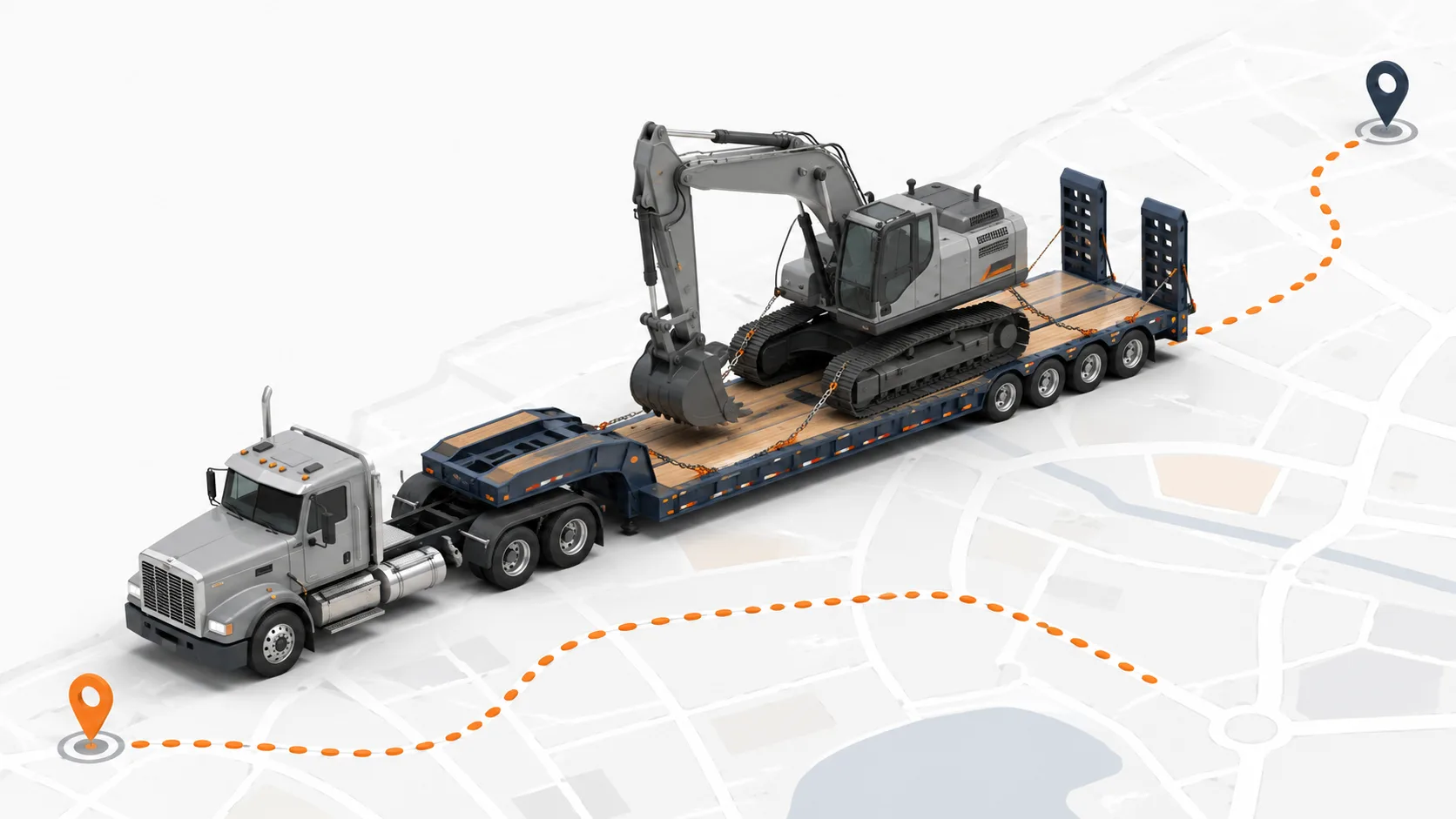
Many of the best equipment deals are not local, and shipping is what stands between a buyer and a machine in another province or state. The good news is that moving heavy equipment is a solved problem with predictable cost drivers. What determines the price — and the paperwork — is mostly the machine’s dimensions and weight, the distance, the trailer it needs, and whether it exceeds the legal limits that trigger permits and escorts. Understand those, and you can price a move before it ever becomes a reason to walk away from a deal.
To a buyer, the number that matters is the landed cost — the price plus the haul. Solve shipping early and distance stops being a deal-killer.
What drives the cost
A heavy-haul quote is built from a handful of inputs. Get these right and the number stops being a mystery:
- Dimensions and weight. Length, width, height and gross weight decide which trailer is needed and whether the load is legal or oversize.
- Distance and route. Mileage is the baseline, but the route matters too — mountain passes, restricted roads and low bridges can change the plan.
- Trailer type. The heavier and taller the machine, the more specialized (and costly) the trailer.
- Permits and escorts. Anything past the legal limits adds permit fees and sometimes pilot/escort vehicles — real cost a carrier builds in.
- Loading. Whether the machine drives on under its own power or needs a crane or ramps affects time and price.
- Timing and season. Lead time, seasonal demand and weather all move availability and rate.
Legal size and weight limits — and when you are “oversize”
Every move starts with one question: does the load fit within standard legal limits, or not? In the United States, the federal no-permit ceilings are 8.5 feet (102 inches) wide and 80,000 lb gross vehicle weight, with height governed by the states (commonly around 13.5–14 feet). In Canada, limits are set provincially — Ontario, for example, caps a load at 2.6 metres wide and 4.15 metres high before a permit is required. Cross those thresholds in width, height, length or weight and the load becomes oversize and/or overweight, which means permits and additional rules. Because the exact figures vary by state and province, confirm the limits for every jurisdiction on the route before you book.
Trailer types and what fits each
Matching the machine to the right trailer is most of the cost decision:
- Flatbed. Simple and economical for smaller, lighter machines and attachments that stay within height limits.
- Step-deck (drop deck). A lower deck height for taller machines that would be over-height on a flatbed.
- Lowboy / RGN (removable gooseneck). The lowest deck and highest capacity, for tall and heavy machines like large excavators and dozers; the gooseneck detaches so the machine can drive on.
The taller and heavier the machine, the more you move toward a lowboy or RGN — and the higher the rate, which is why accurate dimensions are the foundation of an honest quote.
Permits, escorts and travel restrictions
Once a load is oversize or overweight, expect some combination of:
- Oversize/overweight permits. Issued per jurisdiction, so a multi-state or multi-province route can require several.
- Pilot or escort vehicles. Required above certain width, height or length thresholds to warn and guide traffic.
- Travel-time restrictions. Oversize loads are often limited to daylight or specific days and barred during holidays or rush hours.
- Route approval. The permit may specify an approved route around low bridges, weight-restricted roads and other obstacles.
A reputable carrier handles permitting as part of the job — but knowing it is coming helps you read a quote and a timeline correctly.
Crossing the Canada–U.S. border
Moving a machine between Canada and the United States adds a customs layer on top of the transport: import documentation, a customs broker, processing fees and taxes, and any applicable tariffs — much of which a clean USMCA/CUSMA origin can settle. It rewards planning, so line up the paperwork and a broker early rather than leaving the machine waiting at the border. Our dedicated guide, crossing the Canada–U.S. border with heavy equipment, walks through brokerage, the steel and IEEPA tariffs, the 5% GST and duty, USMCA/CUSMA origin, and emissions rules in both directions.
Preparing the machine for transport
- Measure accurately. Length, width, height and weight — including any attachment — drive the trailer choice and the permit question. Guessing here is how quotes go wrong.
- Know how it loads. Confirm whether it runs and drives and can self-load, or whether it needs a crane or ramps.
- Secure and protect it. Lower and secure the attachment, lock or strap moving parts, address leaks, and follow the carrier’s tie-down requirements.
- Have the details and documents ready. Make, model, serial, dimensions, weight and ownership paperwork keep the pickup — and any border crossing — moving.
Getting an accurate quote
The fastest path to a real number is to hand the carrier the right information up front: pickup and delivery locations, the machine’s exact dimensions and weight, whether it self-loads, and your timing. The more precise your inputs, the more accurate the quote and the fewer surprises on moving day. Whether you are buying from a distance or selling to a buyer in another market, putting a real transport figure on the table early is what keeps the deal alive.
Sources & references
Last updated .