
Financing approval for used heavy equipment comes down to one question the lender is asking from two directions: if this deal goes wrong, can the borrower keep paying, and if not, can we sell the machine to cover what’s owed? Everything below is just a detail of that question. Understand the levers before you shop and you can target a machine — and an age, hours and price — you can realistically close on.
A note on numbers: the credit floors, age caps and thresholds here are illustrative industry conventions, not a single published rule. Every lender underwrites its own box, and ranges vary by region and by how strong the rest of your file is. Use them to set expectations, then get a real quote.
Approval is your file and the machine weighed together. A strong borrower can finance a riskier machine; a strong machine can carry a weaker borrower — improve either side and the terms move with it.
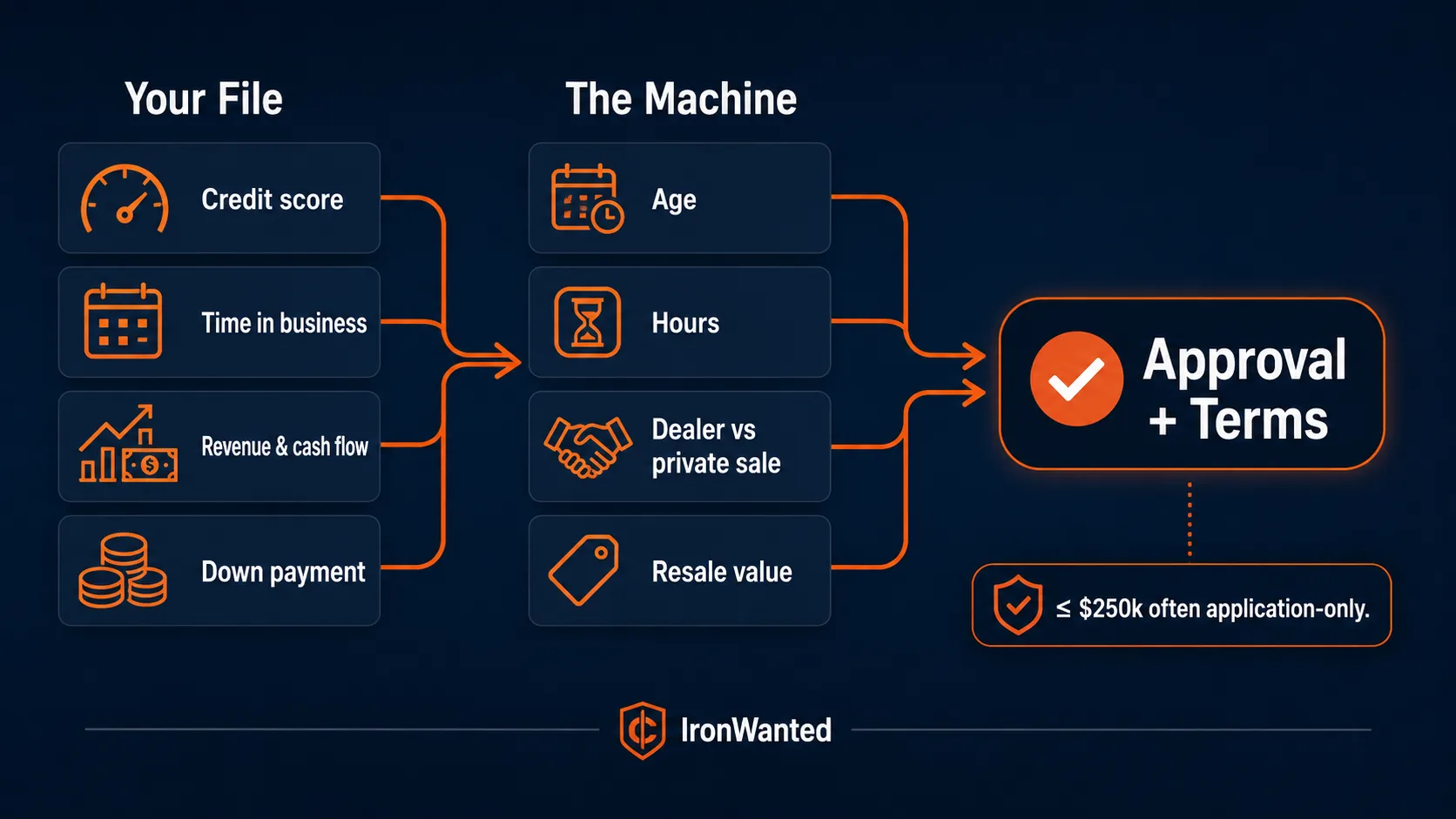
How lenders decide
Most equipment lenders weigh the classic credit factors — your character and history, your capacity to pay, your capital (down payment), the collateral (the machine), and the conditions of the deal. No single factor decides it; a weakness in one can be offset by strength in another. That is why two buyers with the same credit score can get very different answers on the same machine.
Your side: credit, time in business and cash flow
- Credit score. The first screen for most lenders. As a rough, illustrative guide, roughly 600+ is a common minimum and ~680+ unlocks the best pricing, with some specialty lenders going lower at higher cost. Both personal and business credit get pulled.
- Time in business. Established businesses get better terms; application-only programs commonly want around two years under current ownership. Startups can still qualify with strong personal credit, industry experience and a larger down payment.
- Revenue and cash flow. The lender needs to see the business can service the payment. Strong, documented cash flow and low existing debt widen what you can borrow; heavy existing obligations narrow it.
The machine as collateral: age, hours and where you buy
Because the equipment secures the loan, its resale value is central — the lender is valuing the same collateral you are. This is where used deals differ most from new.
- Age. Many lenders cap financeable used equipment around ten years, some 10–15 depending on the asset type and how well it holds value.
- Hours. Treated like mileage: underwriters add current hours plus projected use over the term to estimate what the machine will be worth at the end. High projected hours can shorten the term, raise the down payment, or trigger a decline — IronFinance covers where banks draw the line in can banks finance 10,000-hour equipment?
- Private-party vs dealer. Dealer purchases approve faster on cleaner paperwork; private-party sales are financeable but add conditions — lien/title searches, ownership verification, and often a third-party inspection or video walkaround.
Down payment, term length and loan-to-value
- Down payment. Strong files can sometimes reach 100% financing, but used or higher-risk deals typically want more — commonly 10–20%, and a larger down payment is the single most effective way to rescue a weaker application (IronFinance details Canadian norms in how much down payment lenders require).
- Term length follows remaining life. Newer machines can reach longer terms; older units get shorter ones, because the lender won’t finance a machine past the point it has resale value. The Credit People describe terms scaling down with equipment age.
- Loan-to-value. Used equipment generally borrows a lower share of its value than new, so plan for a gap between the price and what the lender will advance.
Application-only vs full financials
There is a documentation threshold worth knowing. Below a certain deal size — commonly around $250,000 — many lenders approve on the application alone, with no tax returns or financial statements, often same day. Above it you typically submit business financials. Smaller deals also post the highest approval rates: in the ELFA’s CapEx Finance Index, small-ticket equipment deals approved at roughly 82% in September 2025. Keeping a purchase application-only is one reason payment-first shopping closes faster.
Canada vs the U.S.
The collateral logic is the same on both sides of the border — age caps near 10–15 years, the hours-to-end-of-term math, and lien searches on private sales all carry over. The main differences are in programs and framing:
- Government-backed loans. U.S. buyers may use SBA programs for equipment; Canada has no direct SBA equivalent, so most used-equipment deals run through banks or independent equipment-finance companies.
- Bank vs independent lender. Banks apply rigid policy boxes — a single failed rule (max age, minimum score, an excluded category) ends it. Independent lenders underwrite the whole picture, which is why a bank decline isn’t the end of the road.
- Scores aren’t directly comparable. Canadian and U.S. credit systems differ, so treat any score threshold as country-specific.
How to improve your odds
- Clean up your credit first. Pull your report and aim for the best tier you can before you apply.
- Bring a down payment. Even when 100% financing is possible, money down offsets age and hours risk and improves your rate.
- Target financeable equipment. Stay within typical age and hour limits so the machine qualifies for a usable term — use our buying checklist to verify condition.
- Keep it application-only. Where possible, structure the deal under the financials threshold to approve faster.
- Prepare the private-sale file. A clear title/lien search and a third-party inspection ready to go removes the lender’s biggest private-party objection.
Lining the money up before you shop does more than speed the paperwork — a pre-qualified, financed buyer is a stronger buyer, which is exactly why financed buyers make stronger offers.
Sources & references
- ELFA — CapEx Finance Index, September 2025 (equipment-finance approval rates)
- Crest Capital — application-only programs and financing requirements
- SmarterFinanceUSA — qualifying for equipment financing (credit tiers, down payment)
- BitX Capital — what credit score you need to finance heavy equipment
- BlueBridge Financial — guide to financing used equipment (age limits)
- The Credit People — how long you can finance equipment (term by age)
- Mehmi Group (Canada) — used equipment financing: age, hours & inspections
- IronFinance.ca (Canada) — used heavy equipment financing
Last updated .