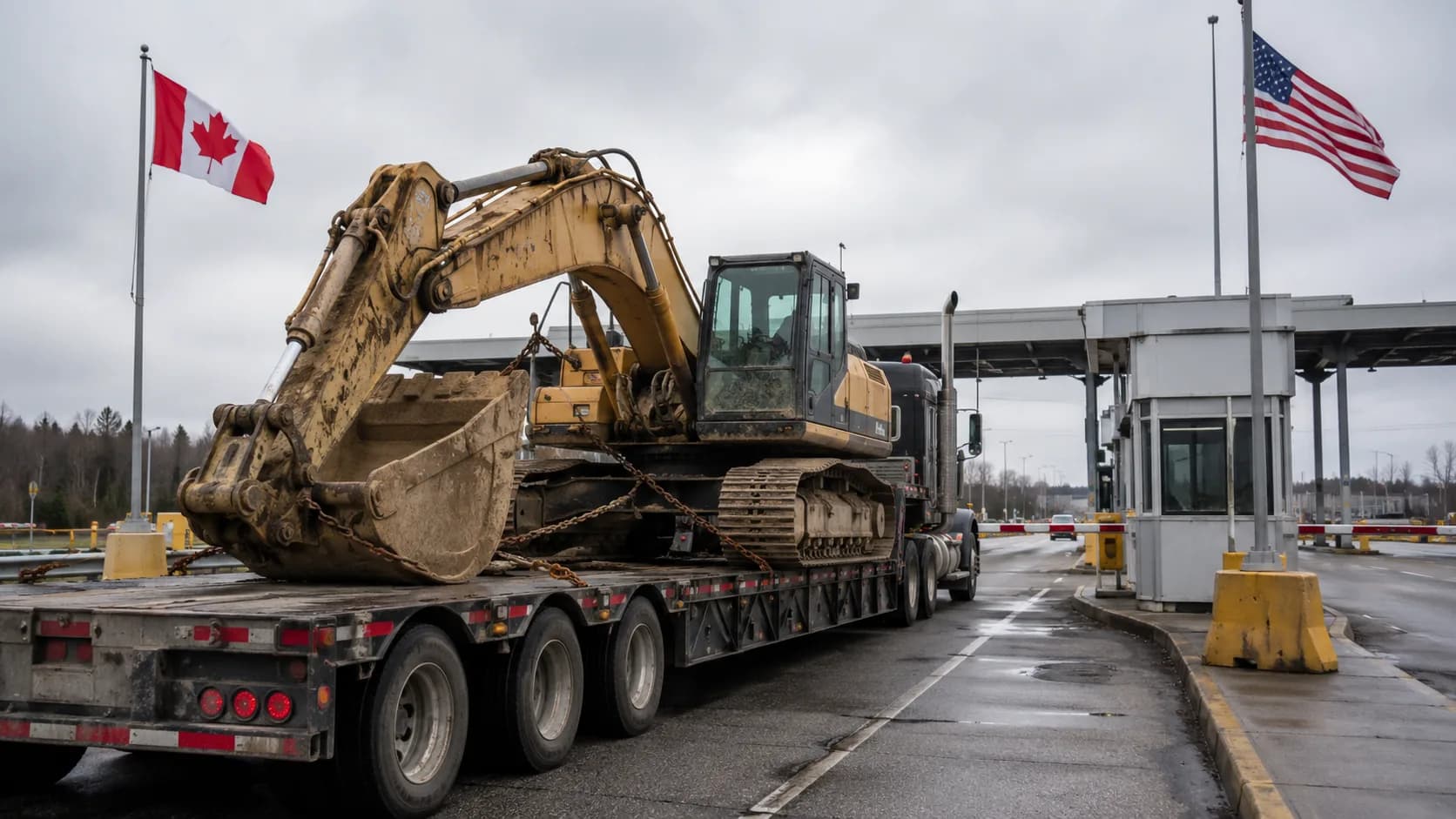
Some of the best equipment deals are on the other side of the border, and the border is exactly what scares buyers off them. The good news: for most used machines the customs side is more predictable than the headlines suggest — base duty is usually zero, and the tariffs everyone is worried about often don’t apply to a whole machine. The catch is that the rules are changing fast, so the job is to know which costs are real for your machine and to confirm them before you commit. This is the customs companion to our guide on the haul itself, shipping heavy equipment.
Read this first — rates change. Tariffs, surtaxes and exemptions across the Canada–U.S. border have been changing rapidly through 2025–2026, by proclamation, retaliatory order, remission and active court challenge. Every figure below is date-stamped and sourced, and every one can change with little notice. Do not rely on these numbers at shipment time — confirm the current treatment for your exact HS code with CBP, the CBSA and a licensed customs broker before you ship.
The border rarely kills a good deal on its own — an unknown tariff does. Pin down your machine’s country of manufacture and HS code first, and most of the uncertainty disappears.
What the border actually adds
Moving a machine across the border layers a few things on top of the transport: a formal customs entry (almost always filed by a broker), government processing fees, import taxes, and — potentially — tariffs. For a used machine the base customs duty is usually the smallest part: most self-propelled construction machinery is classified under its own tariff heading and carries a free or low base rate. What actually moves the total is whether a tariff applies, and that turns almost entirely on where the machine was made.
Customs brokerage: who clears it and what it costs
A licensed customs broker is the person who clears your machine. They classify it (the HS/HTS code), file the entry — a CBP entry summary going into the U.S., a Commercial Accounting Declaration with the CBSA going into Canada — calculate the duty, taxes and fees, claim USMCA/CUSMA preference, and handle other-agency paperwork (such as the EPA filing on the U.S. side). Brokers are licensed by CBP or the CBSA.
- What it costs. Broker entry fees are unregulated and vary, but a single commercial entry commonly runs on the order of US$150–$400+, with high-value or multi-agency entries costing more. Treat that as an illustrative range and get a quote for your shipment.
- Why use one. Classification is where cross-border deals go right or wrong — the same machine under the wrong code can pick up a tariff it didn’t owe, or miss an exemption it qualified for.
Importing into the U.S. (Canada → U.S.)
Bringing a machine south, a broker files a formal entry and you pay the government fees and any applicable duty or tariff.
- Base customs duty. Most self-propelled construction machinery (excavators, dozers, loaders, graders) is generally free of base customs duty at the standard (MFN) rate — confirm the exact code, because some highway trucks carry duty.
- Merchandise Processing Fee (MPF). On a formal entry the MPF is 0.3464% of value, with a minimum of US$33.58 and a maximum of US$651.50 (effective October 1, 2025) — and it is waived for goods that qualify as originating under USMCA.
- Tariffs. This is the variable that matters — covered next.
Tariffs: the steel tariff, the IEEPA tariff, and your machine
Two different U.S. tariff regimes get talked about together, but they hit equipment very differently. Getting the distinction right is the whole game.
The Section 232 steel & aluminum tariff
The U.S. has Section 232 tariffs on steel and aluminum, and Canada’s exemption ended in March 2025; the rate was raised to 50% (in effect since June 4, 2025). Here is the nuance that saves buyers a lot of needless worry: Section 232 applies to steel and aluminum articles and to a specific published list of “derivative” products — not to whole machines. A used excavator is classified under its own machinery heading, which is not on the steel list, so the 50% steel tariff generally does not apply to the machine itself. It can reach certain listed steel parts and attachments (dozer blades and loader/backhoe attachments, for example), and that list expands frequently — so confirm your exact code with a broker rather than assuming either way.
The IEEPA tariff — and the exemption that matters
The tariff most likely to actually touch a whole machine is the IEEPA tariff on Canadian-origin goods — 35% effective August 1, 2025, but with goods that qualify as USMCA-compliant exempt. That exemption is the key to the whole article: a machine that qualifies as USMCA/CUSMA originating avoids this tariff, while one that does not is exposed to it. Which is why the first question on any cross-border deal is not the price — it’s where the machine was built.
Importing into Canada (U.S. → Canada)
Plenty of Canadian buyers find the machine they want on a U.S. lot, and bringing it home is routine — but it has its own costs.
- The entry and the broker. A broker files the Commercial Accounting Declaration with the CBSA; you’ll need a Business Number / import account and a commercial invoice.
- 5% GST. GST of 5% is payable on imported goods at the time of importation; provincial tax (PST/QST) treatment depends on your province and registration status, so check locally.
- Duty. Most machinery is free or low-rate under the Customs Tariff, and CUSMA-originating U.S. goods are duty-free.
- Canadian counter-tariffs. Canada removed its surtaxes on most U.S. goods effective September 1, 2025, while keeping counter-surtaxes on U.S. steel, aluminum and autos. Those rarely capture a whole used machine, but the specific HS code still has to be checked against the order.
USMCA/CUSMA origin: the duty-free key
Qualifying as originating under USMCA/CUSMA is what unlocks duty-free entry in both directions, the IEEPA exemption going into the U.S., and a waived MPF. It hinges on a point buyers often miss: origin is about where the machine was produced, not where it was last used.
- A North-American-built machine (made in the U.S., Canada or Mexico) can qualify as originating even when it’s years old and changing hands used.
- An offshore-built machine (made in Japan, Korea, Europe, etc.) does not become originating just because it sat in a North-American yard — so the duty-free and IEEPA-exemption benefits don’t apply. Confirm the country of manufacture before you count on them.
- Proof. A certification of origin (no prescribed form — the required data elements can sit on the invoice) can be completed by the exporter, producer or importer.
Emissions and vehicle compliance
Beyond customs, a couple of agency rules apply to used equipment — mostly straightforward for off-road machines, more involved for on-highway trucks.
- U.S. emissions (EPA). Importing a nonroad diesel machine generally requires an EPA declaration (Form 3520-21) filed at entry for the engine; a conforming engine with a valid EPA emissions label is the easy case.
- Vehicle compliance. On-highway trucks trigger motor-vehicle rules — DOT/NHTSA in the U.S., and the Registrar of Imported Vehicles in Canada. Off-road construction equipment is generally treated as non-regulated and not subject to those programs — but verify if your unit is road-going.
None of this should stop a good cross-border buy — it just has to be priced and confirmed rather than assumed. Settle the machine’s country of manufacture and HS code, line up a broker, check the current tariff treatment, and fold the customs and transport numbers into the deal the same way you would any other cost. Then make the offer with the landed cost known.
Sources & references
- White House — Restoring Section 232 tariffs (Feb 2025; Canada steel/aluminum exemption ended Mar 12, 2025)
- U.S. Customs & Border Protection — Section 232 steel & aluminum tariffs FAQs (scope; derivative products)
- U.S. CBP — IEEPA (Canada / Mexico / China) tariff FAQ (USMCA-compliant exemption)
- U.S. CBP — Merchandise Processing Fee & preferential trade programs (USMCA waiver)
- U.S. CBP CSMS — User-fee (MPF) changes effective October 1, 2025 (0.3464%; $33.58 min / $651.50 max)
- U.S. CBP — USMCA FAQs (certification of origin)
- U.S. EPA — Importing vehicles & engines (nonroad engines; Form 3520-21)
- CBSA — Guide to importing commercial goods, Step 3: calculating duties & taxes (5% GST on import)
- CBSA — Customs Tariff 2026 (MFN & CUSMA duty rates)
- CBSA — Certifying the origin of goods under CUSMA
- Department of Finance Canada — Canada’s response to U.S. tariffs (counter-surtax status)
- CBSA D19-12-1 / Transport Canada — importing vehicles (RIV; off-road equipment is non-regulated)
Last updated .