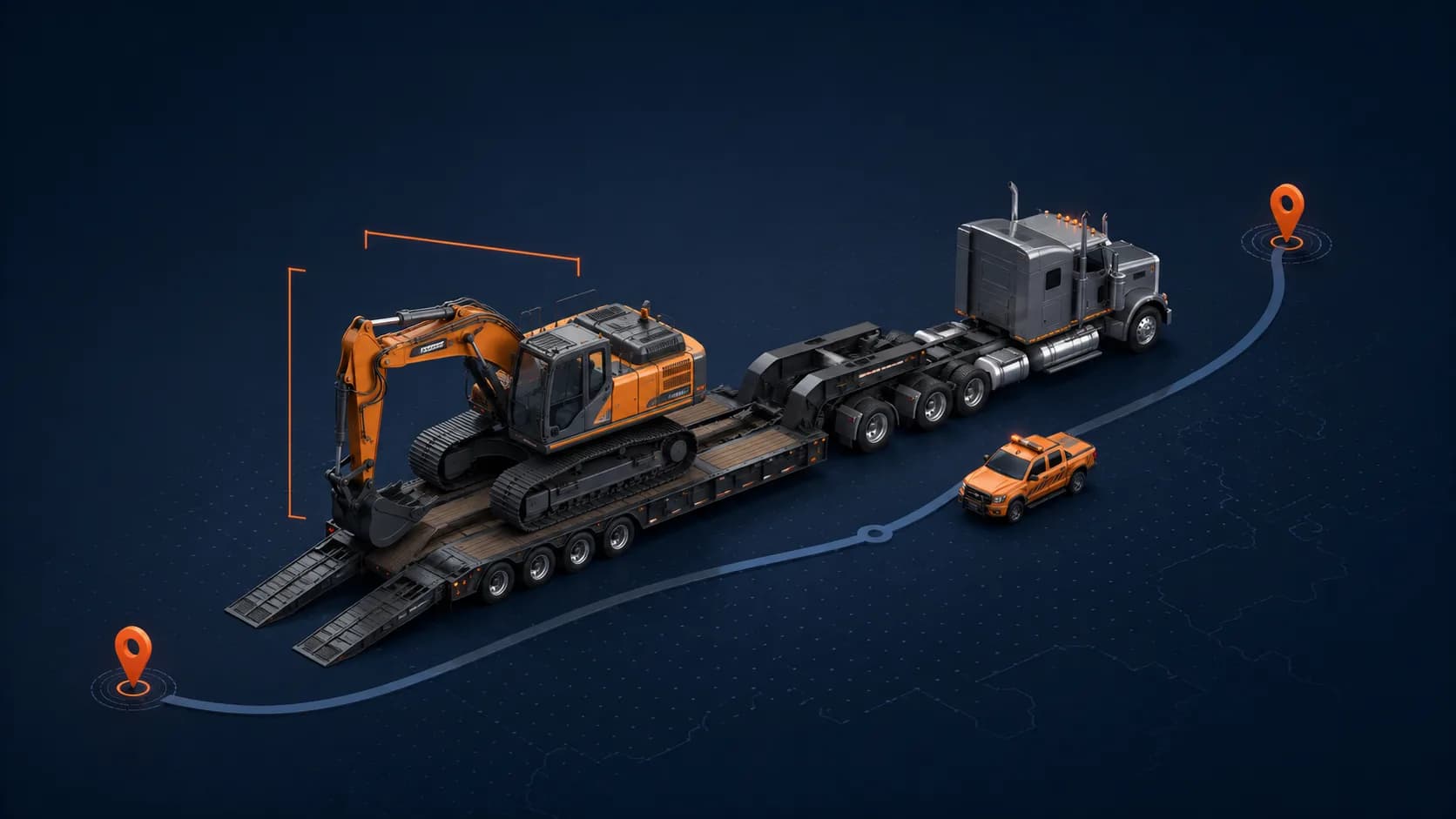
Shipping heavy equipment runs on a layered rule system, and understanding the layers is what keeps a sale from stalling. A load is “legal” up to federal size and weight limits — roughly 80,000 lb gross, 102 inches (8.5 feet) wide, and about 13 to 14 feet high. Anything beyond that needs state or provincial oversize/overweight permits, sometimes pilot-car escorts, and at the extreme a “superload” classification. As the seller you can’t control the distance, but you control the information — accurate dimensions, clear load-out access, and a securable machine are what turn a vague haul into a firm quote and a closed deal.
You’re not just selling a machine — you’re selling a machine the buyer can actually get home, at a price they can predict.
What counts as a legal load
On the U.S. Interstate system, a tractor-trailer is within federal limits when it stays at or below 80,000 lb gross vehicle weight, 20,000 lb on any single axle, and 34,000 lb on a tandem axle group. Those axle limits also fall under the Federal Bridge Formula, which caps how much weight a given set of axles, spread over a given distance, may legally carry — which is why heavy machines ride on multi-axle trailers that spread the load. For width, the federal standard is 102 inches (8.5 feet). There is no federal height limit — states set their own, commonly in the 13.5- to 14-foot range — so height is a route-by-route question, not a single national number.
Most full-size machines stay within the weight limit on the right trailer but exceed one of the size limits once they’re sitting on a deck. That’s normal. It just means the move has to be planned against the rules below, not improvised.
Oversize, overweight, and superloads
Once a load passes the legal limits, it needs a permit — and here’s the part sellers underestimate: the federal government does not issue oversize/overweight permits; that’s a state responsibility. Every state and province sets its own thresholds, fees and conditions, so the same machine can be a routine permitted haul on one route and a complicated one on another. The federal weight limits still apply on the Interstate and can’t simply be waived — permits govern the oversize and special-route side.
At the far end, a load becomes a superload, which triggers the most demanding requirements (engineering review, specific routing, multiple escorts). The threshold is jurisdiction-specific: Ontario, for example, classifies a single-trip move as a superload once it exceeds 120,000 kg gross, 5 metres in width, or 45.75 metres in length, each requiring certified superload escorts. U.S. states set their own superload lines. Most single used machines never reach superload territory — but knowing the ladder (legal → oversize permit → superload) tells you where on it your machine sits.
Permits, escorts, and route
Past certain dimensions, jurisdictions require a pilot (escort) vehicle — sometimes two, sometimes a police escort — and that cost is real and route-dependent. Washington, for instance, requires two escorts on a two-lane highway once a load is wider than 11 feet, with height-sensing escorts for tall loads. Thresholds vary widely by state and province, and the route itself shapes the move: bridge clearances, weight-restricted roads, seasonal load limits and tight jobsite access can force a longer route, a different trailer, or a specific time of day. The takeaway for a seller is simple: the route is part of the price, and it can’t be assumed from distance alone.
The machine picks the trailer
Which trailer a hauler sends is decided by the machine’s height and weight, not the other way around. In rough order of how low and heavy they carry:
- Flatbed / step-deck. Fine for shorter, lighter machines that stay under the height limit sitting on the deck. Step-decks drop the rear deck to gain a little height clearance.
- Lowboy (drop deck). A low center deck lets tall machines ride under the height limit, which is why excavators and dozers usually move on one.
- RGN (removable gooseneck). The front detaches into a ramp so a machine can drive on under its own power — the workhorse for heavy, drive-on iron.
The practical point for sellers: a machine’s loaded height and weight, and whether it can drive on under its own power, determine the trailer and therefore the cost. Tell the hauler accurately and the quote holds.
Securement on the trailer
Tie-down isn’t optional or improvised — it’s federally regulated, and a machine that’s easy to secure is faster (and cheaper) to load. Under 49 CFR 393.130, heavy equipment that runs on wheels or tracks and individually weighs 10,000 lb or more — loaders, dozers, excavators — must be restrained against movement in all four directions (forward, rearward, sideways and vertical) using a minimum of four tiedowns, each attached to a separate anchor point. On top of that, the general rule in 49 CFR 393.106 requires the combined working load limit of the tiedowns to be at least half the weight of the load.
For a seller, two things follow: make sure the machine’s factory tie-down and lifting points are intact and accessible, and secure any loose attachments or articulation before pickup. A machine that can’t be tied down properly doesn’t ship.
Pickup access and loading
The move starts in your yard. Before anyone quotes the haul, be clear about how the machine gets onto a trailer and whether a truck can even reach it.
- Can it load under its own power? A machine that drives onto an RGN is cheaper and faster to load than one that needs a second machine or a crane. Say so up front — it changes the quote.
- Is there room for a truck and trailer? Confirm the approach, ground conditions, overhead clearances and turning space at the pickup site.
- Is the machine ready to move? Secured attachments, no active leaks, and able to be tied down without surprises keeps the load-out from stalling.
Be quote-ready
A transport quote is only as good as the information behind it. Have these ready and a hauler can give you a firm number instead of a guess that moves later:
- Make, model and accurate dimensions. Length, width, height and weight as it sits — the numbers that decide trailer, permits and escorts.
- Pickup and delivery locations. Real addresses or at least towns — route shapes the price as much as distance.
- Loads-under-power, yes or no. And whether loading equipment is on site.
- Timing. A flexible window is usually cheaper than a fixed date.
Cost itself is driven by distance, dimensions, weight, permits, escorts, fuel and route — there’s no flat per-mile rate for oversize iron, which is exactly why accurate inputs matter. Vague details produce a quote that changes; precise ones produce a number that holds.
Crossing the border
A cross-border buyer is often your best buyer, and the move is routine when it’s handled right. All commercial goods entering Canada must be reported to the Canada Border Services Agency, with the carrier reporting the shipment electronically or by cargo-control document. Heavy equipment that meets USMCA rules of origin can generally move between the U.S. and Canada duty-free when the proper certification of origin is provided. Cross-border duty and tariff treatment can change, so confirm current requirements (and use a customs broker for anything but the simplest move) rather than relying on a checklist that may be out of date.
How shipping affects the deal
To the buyer, the number that matters is the landed cost — your price plus the haul. A seller who can hand a buyer a realistic transport figure early removes the biggest unknown standing between interest and an offer. You don’t have to pay for shipping to benefit from pricing it: simply making the move predictable — accurate dimensions, known access, a securable machine, a sensible route — widens your buyer geography and keeps distance from quietly killing a deal you’d otherwise close.
Sources & references
- FHWA — federal truck size & weight limits (and why permits are a state option)
- 23 CFR §658.17 — Interstate weight limits and the Federal Bridge Formula
- FHWA — Comprehensive Truck Size and Weight (102-inch width; no federal height limit)
- Ontario — oversize/overweight permits and superload thresholds
- Washington State — escort vehicle requirements (WAC 468-38-100)
- 49 CFR §393.130 — securement of heavy vehicles, equipment and machinery (four-tiedown rule)
- 49 CFR §393.106 — general cargo securement and working load limit
- Canada Border Services Agency — reporting commercial goods (Guide 4)
Last updated .