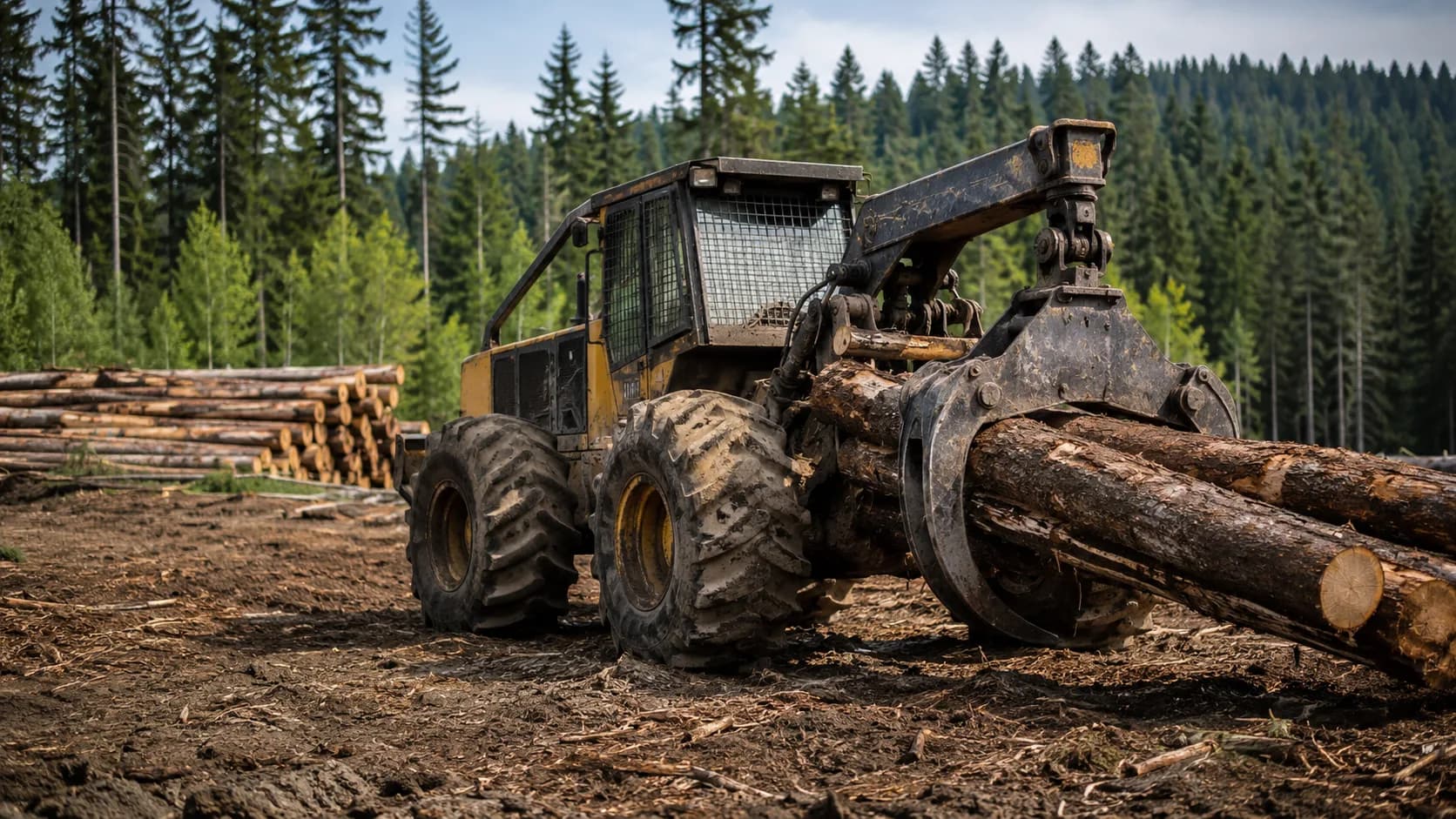
Forestry duty is among the harshest in heavy equipment: continuous high hydraulic load, airborne debris, high underbody heat, hard impacts, and a real fire risk. That means hours alone tell you even less here than usual — what matters is the condition of the wear systems and the working attachment, and whether the machine has been fighting heat and debris its whole life. This guide builds on our general buying checklist with the forestry-specific things a generic walkaround misses.
In the bush, the meter is the least reliable number on the machine. The undercarriage, the cooling package and the working head tell you what you’re really buying.
Checks for every forestry machine
Run these on anything before you look at the machine-specific details below.
- Hours in severe-duty context. Many forestry machines run two clocks — the carrier and the attachment — so ask for both and watch for mismatches (a rebuilt engine on a high-hour frame is common and changes the price).
- Engine, cooling and debris packing. Open the cooling compartment and look for packed needles, chips and oil-soaked debris in the radiator and coolers. Debris-clogged coolers cause overheating and are a leading fire-prevention failure point; confirm reversing/variable fans and clean-out access work.
- Hydraulics under load. Forestry hydraulics run near-continuous high pressure. Inspect hoses, fittings and cylinders for leaks, listen to the pump, and cycle the boom, head and grapple for smoothness, drift and chatter — leaking oil near hot surfaces is both a repair and a fire hazard.
- Fire history and burn damage. Look for scorched paint, melted or re-spliced wiring, hoses replaced in clusters, and fire-extinguisher or suppression-system tags. Confirm any fire-detection system powers up — Tigercat’s heat detectors, for reference, trip at 177°C (350°F).
- Undercarriage or tires/chains. On tracked machines this is the biggest wear cost — check for worn shoe bolts and leaky roller/idler seals; Tigercat notes no roller point should exceed about 80°C (180°F) and that correct track sag can yield roughly 50% more track-assembly life. On wheeled machines, inspect tire carcasses, uneven wear and skidder-chain condition.
- Guarding, sweeps and Lexan. Belly pans, lower-frame guards, brush sweeps, ROPS/FOPS/OPS cab structure and uncracked polycarbonate windows should all be intact. Hammered or missing guards signal hard use and are costly to replace.
Skidders
Test the working tool fully and focus on the joint that carries every load.
- Grapple or winch. Open, close, squeeze and rotate the grapple, or test the winch pull-in, free-spool and cable/clutch condition.
- Articulation (center) joint. It carries the full load — it must be tight and flex-free, with intact grease fittings and aligned upper/lower pins.
- Tires and chains. Looseness alone is fine, but chain clatter suggests it has been loose long enough to damage sprockets; check tires for uneven or bald wear.
- Transmission and drive. Drive it — the transmission should shift cleanly, and hydrostatic drive motors and pumps shouldn’t leak.
Feller bunchers
The saw head is the consumable, and this class carries the highest fire risk — be extra thorough on cooling and burn signs.
- Saw head. Inspect the disc (“hot saw”) and its carbide teeth and pockets, disc and saw motor for wear, cracks and imbalance; intermittent/clamp-saw bars wear too.
- Accumulator arms and grapple. The arms that gather and hold cut stems take cyclic load — check for cracks, worn pins and cylinder drift.
- Leveling system. On steep-slope machines, run the leveling through its full range and confirm it holds without leaks or hesitation.
Harvesters & processors
The head is most of the value and the fastest-wearing part — and a head that won’t measure accurately can’t cut logs to spec. Use a harvester inspection checklist as a field template.
- Feed rollers and arms. Check roller wear and grip, plus the roller-arm cylinders, bearings and pins.
- Delimb knives. Inspect the moving and fixed knives for sharpness, chips and cracks.
- Saw unit. Bar, chain tension, auto-tensioner and chain-shot guarding.
- Measuring system and computer. Test the length/diameter measuring and control computer for calibration — an out-of-cal head costs you in rejected loads.
Knuckleboom & log loaders
High cyclic loading lives in the pins and welds, so inspect them closely.
- Boom and stick pins. Check every pin and bushing for play, and the weld joints for cracks.
- Slew/turntable. The bearing should be tight and rotate smoothly without notchiness.
- Grapple. Cycle and load it — tongs, rotator, cylinders and hoses.
- Mount and carrier. Confirm the carrier (trailer, track or truck) and the loader-to-carrier connection are sound, and verify any “new pins and hoses” refurb claims against the actual machine.
Log trucks
A log truck is a road vehicle doing heavy off-road duty, so inspect the chassis and the trailer as carefully as the load gear.
- Frame and suspension. Inspect frame rails for cracks, prior welds and corrosion, and check the suspension for sag and damage.
- Brakes and air system. Test the full air-brake system; get (or do) a current DOT inspection before purchase.
- Trailer. Drum brakes, springs, bunks/stakes and reach — and confirm it’s road-legal.
- Self-loader. If equipped, treat the mounted knuckleboom as its own inspection (see above).
None of these findings are automatic deal-killers — the point of finding them is to price them into the offer. And because forestry iron is often financed, line the money up early: see what gets approved for financing, and for Canadian buyers, IronFinance covers logging equipment financing in Canada.
Sources & references
- Tigercat — Track to Success (undercarriage service: roller temp, shoe-bolt torque, track sag)
- Tigercat — Fire detection on drive-to-tree feller bunchers & mulchers (detector trip 177°C/350°F)
- Tigercat — Burn Less (cooling-package debris management & fire risk)
- MEVAS — Harvester inspection checklist (head, hydraulics, undercarriage)
- Waratah — H212 harvester head (feed rollers, knives, measuring system)
- Tigercat — Felling heads (disc saw / intermittent saw & accumulator arms)
- Lumbermens Co — Tips for buying a used skidder
- Equipment World — How to make sure your heavy equipment doesn’t burst into flames
Last updated .