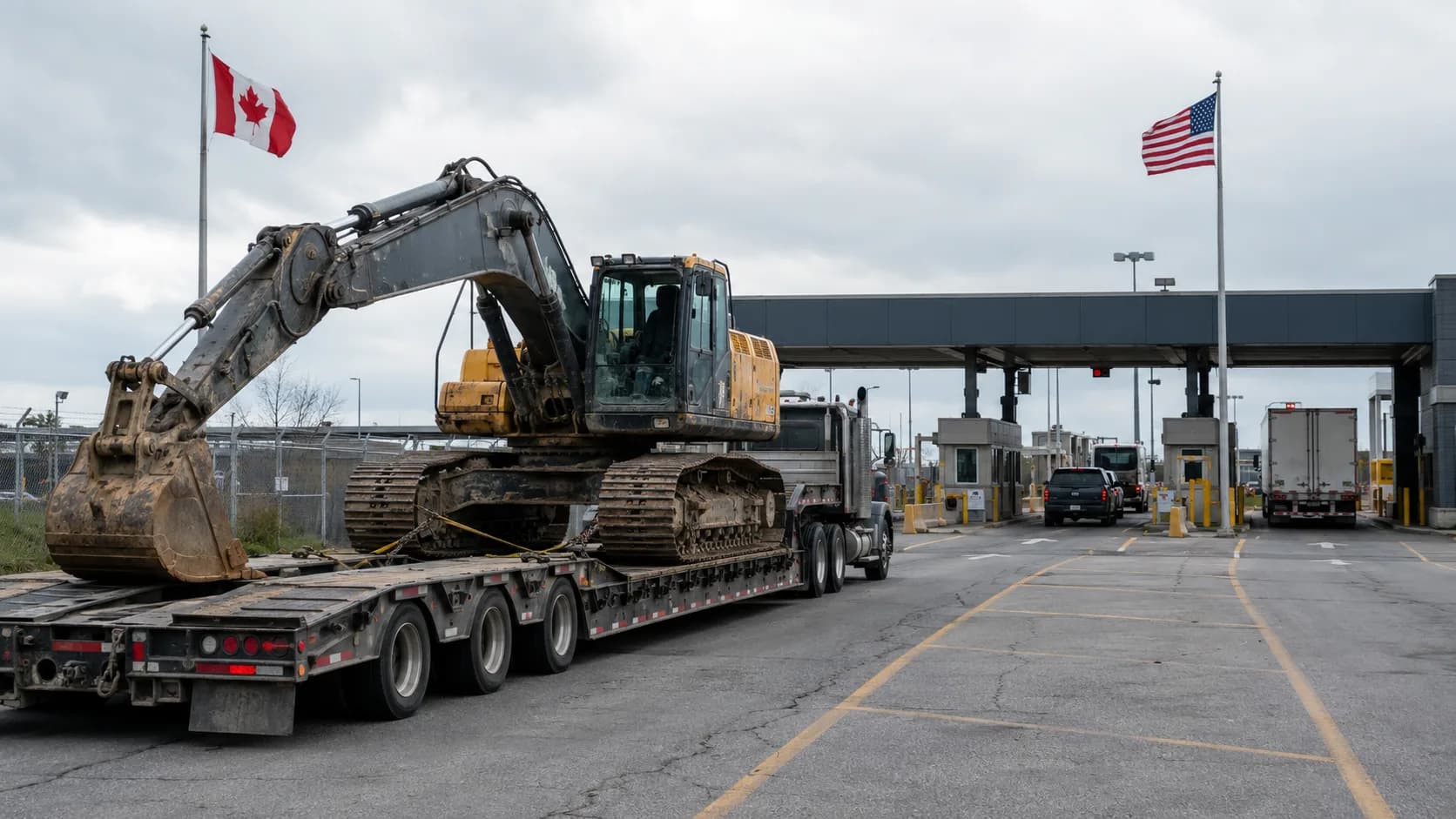
If the tariff headlines have you second-guessing a cross-border equipment deal, here’s the practical version for used machines — current as of June 2026. The short story is better than the headlines suggest: for most used machines the tariff everyone fears doesn’t apply, and the one that can is usually avoidable with a clean origin.
Heads up — this changes fast. Cross-border tariffs have moved repeatedly through 2025–2026 by proclamation, retaliation and court challenge. Treat every figure here as a dated snapshot and confirm your exact HS code with CBP, the CBSA and a licensed broker before you ship. For the full mechanics, see our guide to cross-border equipment shipping.
The first question on a cross-border deal isn’t the price — it’s where the machine was built. That one fact decides whether the big tariff applies.
Where things stand
Two U.S. tariff regimes dominate the conversation. The Section 232 tariff on steel and aluminum sits at 50% (in effect since June 4, 2025, after Canada’s exemption ended in March 2025). Separately, an IEEPA tariff applies to Canadian-origin goods. They sound similar but treat a used machine completely differently.
Does the steel tariff hit your machine?
Usually not. Section 232 applies to steel and aluminum articles and to a published list of “derivative” products — not whole machines. A used excavator is classified under its own machinery heading, which isn’t on the steel list, so the 50% steel tariff generally does not apply to the machine itself. It can reach certain listed steel parts and attachments, which is a real cost on the parts side — more on that in our post on why attachment and wear-part prices are climbing.
The tariff that does matter — and the way around it
The exposure that can actually land on a whole machine is the IEEPA tariff: 35% on Canadian-origin goods, with goods that qualify as USMCA-compliant exempt. That exemption is the whole game. A machine that qualifies as USMCA/CUSMA originating avoids it; one that doesn’t is exposed. And origin means where the machine was made, not where it was last used — a North-American-built machine can qualify even years later, while an offshore-built one (Japan, Korea, Europe) does not.
Bringing iron into Canada
Buying from a U.S. seller and importing into Canada is routine. Expect a customs entry through a broker, 5% GST at the border, and duty that is mostly free under MFN or CUSMA for machinery. Canada removed its surtaxes on most U.S. goods in September 2025, while keeping counter-surtaxes on U.S. steel, aluminum and autos — which rarely capture a whole used machine, but check the HS code.
What to do right now
- Confirm the country of manufacture. It decides USMCA eligibility and your IEEPA exposure — ask before you fall for a specific unit.
- Get your HS code classified. A broker confirms whether any listed part or tariff touches your machine.
- Price the landed cost. Fold customs, GST/duty and transport into the offer — get a real shipping quote rather than guessing.
Sources & references
- White House — Restoring Section 232 tariffs (Feb 2025; Canada exemption ended Mar 12, 2025; 50% since June 4, 2025)
- U.S. CBP — Section 232 steel & aluminum tariffs FAQs (scope; derivative products)
- U.S. CBP — IEEPA (Canada / Mexico / China) tariff FAQ (35%; USMCA-compliant exemption)
- Department of Finance Canada — Canada’s response to U.S. tariffs (counter-surtax status)
Last updated .