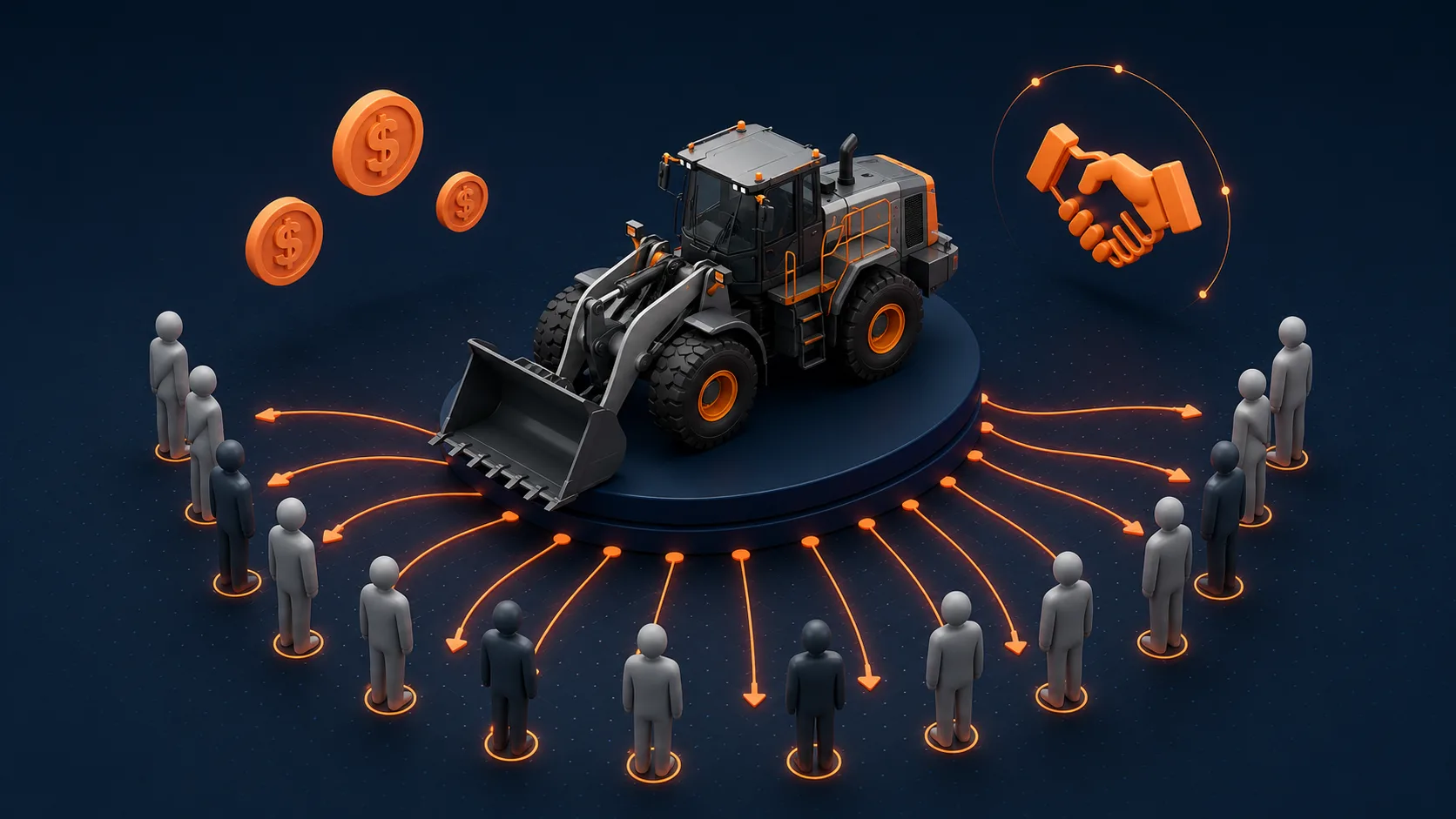
Most heavy-equipment buyers don’t pay cash — they finance. According to the Equipment Leasing & Finance Foundation, 82% of U.S. businesses use some form of financing to acquire equipment, and construction leads every sector at 85%. For a seller, that one fact changes how you should think about price: buyer financing isn’t the buyer’s problem to solve alone — it’s what widens your buyer pool. A machine more buyers can finance is a machine more buyers can afford, and that demand is exactly what protects your price.
Cash buyers shop on price. Financed buyers shop on payment — and there are far more of them.
Most equipment buyers finance — especially in construction
Financing isn’t a niche; it’s how the industry buys. The Foundation’s research found that construction end-users are the most likely of any industry to finance their equipment, at 85% — ahead of health care (70%) and professional services (66%). At the macro level, ELFA reports that of the $2.3 trillion U.S. businesses invested in equipment and software in 2023, roughly 57.7% (about $1.34 trillion) was financed through loans, leases and lines of credit. The practical message for a seller is simple: the buyer most likely to want your machine is also the buyer most likely to finance it.
Loans vs. leases: how buyers actually pay
Financed buyers come in two main flavours, and the machine is the collateral in both:
- Equipment loan. The buyer borrows, makes fixed payments over a term, and owns the machine while the lender holds a lien that’s released at payoff. The buyer carries maintenance, insurance and depreciation. The lender perfects its interest by filing a UCC-1 financing statement against the equipment (a PPSA registration in Canada).
- Equipment lease. The buyer pays to use the machine with an end-of-term choice. A fair-market-value (operating) lease lets them return, renew or buy at market value; a $1-buyout (capital) lease transfers ownership for a final dollar. Either way, the seller is paid in full at the sale — the financing sits between the buyer and their lender.
You don’t arrange the buyer’s loan, and you get your money at closing regardless of which structure they use. What matters to you is that more buyers can structure a purchase they can live with.
Financing widens your buyer pool
A machine priced in the tens or hundreds of thousands sits above what most owner-operators and small contractors can pay outright. When those buyers can spread the cost over a term, a unit that was out of reach becomes a realistic purchase. With more than eight in ten businesses financing their equipment, pricing or positioning your machine as cash-only quietly removes most of the market. Financing adds demand — without you lowering anything — and demand is what holds a price up.
Pre-qualified buyers make cleaner, stronger offers
A buyer who has already lined up financing negotiates differently. They know their number, they can close on a timeline, and they’re far less likely to vanish after you’ve taken the machine off the market. That closing certainty is worth real money: it lets you hold firmer on price because you’re dealing with a buyer who can actually complete, not one still hoping to find the funds.
What makes your machine easy to finance
Here’s the part sellers miss: the buyer’s lender is underwriting your machine as collateral, so the condition of your listing directly affects whether the buyer gets approved on it. A lender weighs the machine’s age, hours, condition and documentation alongside the borrower’s credit — and an older, higher-hour, or poorly-documented machine is harder and costlier to finance, which shrinks the pool of buyers who can complete on it. You can’t change the year, but you can remove every other obstacle:
- Records and condition. A documented, well-maintained machine is easier to underwrite than an unknown-history unit. Your service history helps the buyer’s approval, not just your asking price.
- Accurate specs and hours. Clean, honest listing details let a lender value the collateral without the back-and-forth that slows or sinks an approval.
- Clear title, no surprise lien. If you still owe on the machine, an existing lender’s UCC-1 (or PPSA registration in Canada) is on record, and the buyer’s lender will find it. Clearing or disclosing it before you list keeps the financing — and the sale — from dying at the bank.
The tax incentives pulling buyers into the market
Financed buyers aren’t only motivated by payments — they’re motivated by tax treatment, and current U.S. rules strongly favour buying equipment, including used machines. For the 2025 tax year, IRS Section 179 lets a business immediately deduct up to $2,500,000 of qualifying equipment, with the deduction phasing out once purchases pass $4,000,000. Separately, recent federal law (the One Big Beautiful Bill Act) permanently restored 100% bonus depreciation for qualifying property — explicitly including used equipment — acquired and placed in service after January 19, 2025.
For a seller, that’s a tailwind: a buyer who can write off a large share of the purchase in year one has a stronger reason to act now, and used equipment qualifies. These figures are set by tax year and individual situations vary, so a buyer should confirm current limits with their tax advisor — but the direction of the incentive is firmly on the side of getting deals done.
Position the listing for financed buyers
You don’t arrange the loan, but you set the table. List the machine the way a lender and a buyer both need to see it: real photos, accurate hours and specs, documented condition, clear title, and a price that sits in the realistic range so the financed number makes sense. When a buyer can picture the payment and a lender can value the machine, the deal has far fewer places to stall — and the two most common reasons a deal dies after the handshake, financing and transport, are both handled before they become problems.
Sources & references
- Equipment Leasing & Finance Foundation — 2024 Horizon Report (82% of businesses finance equipment; construction 85%)
- Equipment Leasing & Finance Association (ELFA) — industry overview ($2.3T invested in 2023; 57.7% financed)
- IRS — Publication 946, How To Depreciate Property (Section 179 limits; bonus depreciation)
- IRS — Instructions for Form 4562 (2025 Section 179 limits; 100% special depreciation allowance)
- U.S. Bank — equipment loan vs. lease structures (FMV vs. $1-buyout, classification)
- Pathward — equipment loan vs. lease (lien, down payment, ownership)
- U.S. UCC §9-310 — perfection of a security interest by filing (UCC-1)
- Ontario — register or search a lien (Personal Property Security Registration)
Last updated .