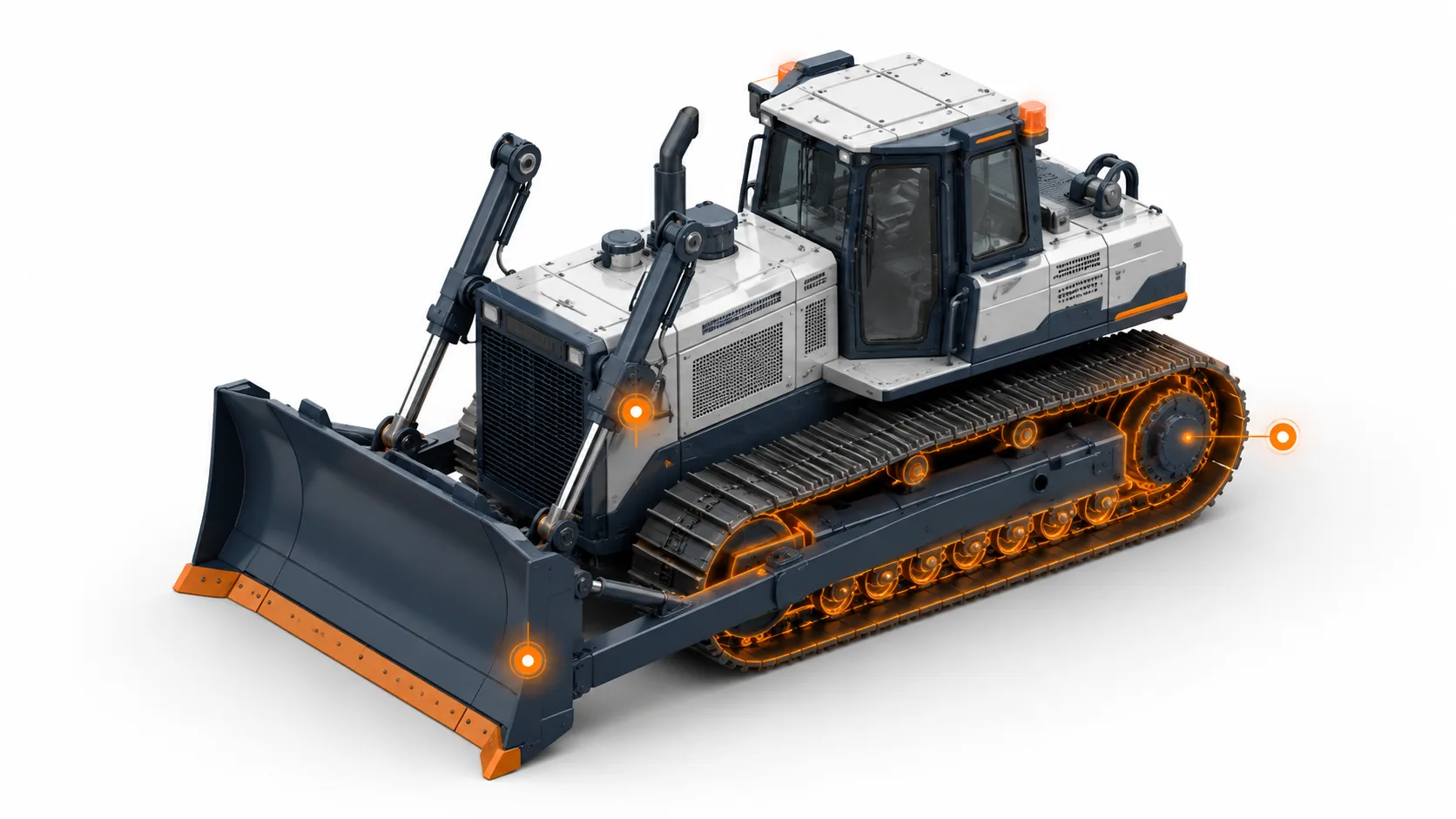
A used crawler dozer can be a great buy or a money pit, and the difference is usually found in the parts that are slowest to inspect and most expensive to fix. Before you talk price, work through the machine methodically — undercarriage first, then the blade, drivetrain, engine and hydraulics, then the paperwork. The goal is not to find a perfect machine; it is to find every cost before you own it, so each one becomes a negotiation instead of a surprise.
On a dozer, the undercarriage is roughly half the maintenance cost. Inspect it like it is half the purchase — because in remaining-life terms, it often is.
Start with the undercarriage
The undercarriage is the most expensive wear system on a tracked dozer and the first thing a serious buyer evaluates. Caterpillar’s own owner guidance is blunt: taking care of the undercarriage typically makes up about 50% of a machine’s total maintenance cost. Yet the trade press notes a crawler undercarriage is only about 20% of a dozer’s purchase price but 50% or more of its lifetime repair tab. Worn-out tracks do not stop the machine from running, which is exactly why a tired undercarriage is so easy to under-price — the cost is deferred, not visible. Have the major components assessed and expressed as a percentage worn:
- Rails and links. Check for wear, cracking and end play across the chain.
- Bushings and pins. A common, costly wear point; ask whether the chain has ever been turned.
- Rollers and idlers. Look for leaks, flat spots and seized rollers, both carrier and bottom rollers.
- Sprockets. Hooked or sharp teeth indicate advanced wear and accelerate chain wear.
- Grouser height and track tension. Low grousers cut traction; improper tension wears everything faster (more on tension below).
Treat the undercarriage as one interdependent system, not a list of parts — wear on one component accelerates wear on the others, which is why a whole-system view is what actually supports a remaining-life estimate. A documented undercarriage at light wear supports a very different price than one near the end of its life.
How undercarriage wear is actually measured
Wear is graded as a percentage versus new, measured per side of the machine. A professional or thorough buyer measures the carrier rollers, bottom rollers, track shoes (pad width, grouser height and scalloping), front and rear idlers and sprockets, plus rail pitch — the stretch across five pins, center to center, with the track tensioned — along with rail height and bushing diameter, comparing each reading to the figures in the OEM service manual using a tape, depth gauge and calipers (or a sonic gauge). That same source quotes a Komatsu remarketing specialist putting a professional undercarriage assessment at roughly $200 to $300 — cheap insurance on a machine where the undercarriage can be the largest cost.
Pay attention to track tension. The same inspection expert warns that owners who run their tracks too tight can see two to three times the internal wear rate on pins, bushings and idlers; look for mud packing in the sprockets and link assemblies as a tell that the machine ran packed and over-tight.
Blade, C-frame and linkage
The blade and its mounting take constant structural load, so look past the paint for fatigue and repair history:
- Blade and moldboard. Check the cutting edge and end bits for wear, and the moldboard for cracks, dents and patch welds.
- C-frame, push arms and trunnions. Inspect for cracking, sloppy pins and previous repairs — structural fixes here are not cheap.
- Tilt and angle cylinders. Look for leaks, scored rods and drift when the blade is held under load.
- Ripper (if equipped). Check the shanks, tips and mounting for wear and damage.
Drivetrain and final drives
How the machine moves and steers is a major cost center, and the final drives deserve special attention because the economics are asymmetric. Caterpillar states that repairing a component before it fails costs two to three times less than an after-failure repair — so a final drive caught early is a very different bill than one run to destruction. Run the machine through its functions and check for the warning signs Caterpillar’s final-drive guidance lists:
- Final drives. Listen for unusual noise, and check for overheating, vibration, leaks and especially metal debris on the magnetic drain plug, which points to worn gears, bearings, sprockets or failing seals.
- Transmission. Whether hydrostatic or powershift, check for smooth power, clean engagement, no slipping and even tracking with no unexpected pull.
- Steering and brakes. Confirm the machine steers cleanly both directions, holds on a grade, and shows no brake slippage.
Engine, hydraulics and fluids
A lab report on the fluids reads the inside of the machine without opening it, and it is the cheapest insurance you can buy on a used dozer. OEM programs — Caterpillar’s S·O·S Services and Komatsu’s KOWA — test engine oil, hydraulic fluid, coolant and powertrain lubricants for early wear metals and contaminants like water, fuel, glycol and dirt. The chemistry is specific: a Cat S·O·S sample is screened for wear metals plus silicon (which indicates dirt) and sodium (which indicates water or coolant), and a combined rise in copper and iron in a hydraulic sample points to a failing hydraulic pump. Beyond the fluids, watch the rest of the package:
- Engine. Watch for blowby, excessive smoke, hard starting, leaks and the condition of the coolant. Back the impression with an oil sample.
- Hydraulics. Check cylinders for leaks and the system for weak or slow functions and contaminated fluid.
- Cooling. Note any persistent leaks and check the radiator and coolers for damage and blockage.
Hours, work history and the operator
The meter is context, not a verdict. Weigh it against how the machine lived — as one Cat dealer puts it, a newer dozer with high hours in abrasive sand can be in far worse shape than an older machine dedicated to light grading, because the underfoot conditions a dozer worked in are the biggest determinant of undercarriage life:
- Application. Rock, a quarry or a landfill is a far harder life than finish grading. Ask what work the machine actually did.
- Hours versus age. Compare the meter to the year — very high hours mean hard use; very low hours can mean it sat, with its own fluid, seal and corrosion issues.
- Documented major work. A reman engine, rebuilt transmission or new undercarriage — with invoices — resets part of the machine’s remaining life and supports a higher price.
Records, serial verification and liens
- Service history. Regular intervals and repair invoices signal a machine that was protected; gaps signal deferred cost.
- Serial number. Confirm the serial plate matches the paperwork and that the machine is what the listing says it is.
- Liens and ownership. Make sure no undischarged lien rides with the machine. An equipment-history report such as NER’s IRONcheck bundles a UCC lien search with theft-database and insurance-claim checks; you can also search liens directly through state UCC filing offices or, in Canada, a provincial PPSA registry.
When to walk away
Most findings are negotiable if you price them. A few should make you pause: an undercarriage near end-of-life on a machine priced as if it were fresh, structural cracks or repairs hidden under new paint, an hour reading nothing supports, final-drive debris on the magnetic plug, and a seller who cannot or will not produce records, a matching serial or a clean title. A dozer that is honest about its flaws and priced for them beats a “clean” one with no paper trail.
Sources & references
- Caterpillar — Dozer Undercarriage Maintenance (undercarriage is about half of maintenance cost)
- Construction Equipment — The Discipline of Undercarriage Management (~20% of purchase price, 50%+ of lifetime repair)
- Equipment World — Inspection Checkpoint: How to Inspect a Used Small Dozer (per-side wear measurement, track tension)
- Caterpillar — Repair Before Failure (repairing before failure costs 2–3x less)
- Caterpillar — Final Drive Maintenance Management Guide (failure indicators)
- Caterpillar — S·O·S Services fluid analysis (what oil analysis detects)
- Komatsu — Oil & Wear Analysis (KOWA)
- Peterson Cat — Know the Numbers, S·O·S fluid analysis (wear metals, silicon, sodium, FT-IR)
- Thompson Machinery — Choosing a Used Dozer (read hours in the context of application)
- National Equipment Register — IRONcheck (UCC lien, theft and claim history)
- NASS — UCC filing offices (lien search)
- Ontario — Personal Property Security Registration (PPSA lien search)
Last updated .